



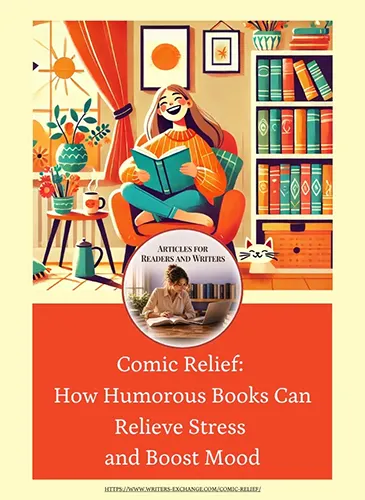
Comic Relief: How Humorous Books Can Relieve Stress and Boost Mood
Why Laughter Is Not a Luxury
There is a particular kind of reader who reaches for something funny when life becomes difficult. Not because they are avoiding reality, but because they understand, perhaps instinctively, that laughter is one of the most effective tools we have for staying sane. Comedy fiction does not pretend the world is without trouble. At its best, it looks directly at the absurdity, the frustration, and the small indignities of human existence and laughs at them. That is not escapism. It is a form of courage.
The physiological case for humour has been building for decades. Research published in peer-reviewed journals, including a 2023 meta-analysis across eight studies in the journal PLOS ONE, found that spontaneous laughter reduced cortisol levels by an average of nearly 32 per cent compared to control groups. A single laughter session was enough to produce a reduction of around 37 per cent. Separate work from Loma Linda University found that even the anticipation of laughter raised levels of beta-endorphins, the brain chemicals that alleviate depression, by 27 per cent. These are not trivial effects. They are measurable changes in the body's stress response, produced by something as ordinary as finding a book funny.
For readers, this matters because fiction is one of the most reliable ways of inducing genuine laughter. A well-crafted comic novel does not just deliver jokes. It builds a world, establishes characters you care about, and then places those characters in situations that are funny precisely because they feel real. The laughter it produces tends to be sustained and warm rather than the sharp, brief release of a single joke. And that sustained engagement with something playful, something that demands nothing of you except that you keep reading, is genuinely restorative.
What Great Comedy fiction Actually Does
It is worth being clear about what separates truly funny fiction from fiction that is merely trying to be funny, because the distinction matters both for readers choosing their next book and for writers attempting the genre.
The best comic novels work because their humour emerges from character and situation rather than being applied on top of them. P.G. Wodehouse, whose Jeeves and Wooster novels remain among the most celebrated comic works in the English language, understood this completely. The Code of the Woosters, published in 1938, is funny not because it contains a sequence of jokes but because Bertie Wooster is a specific and deeply realised human being, a well-meaning man of almost no practical intelligence, navigating a world that keeps demanding things of him that are entirely beyond his capabilities. The comedy comes from watching someone we like flounder helplessly while remaining cheerful and optimistic about it. Wodehouse's sentences are constructed with extraordinary care, and even a single line reveals the precision of his craft. When Bertie observes that a man was "not so much disgruntled as far from being gruntled", the joke works because it takes a word we assume has a simple opposite and reveals that it does not, while also precisely characterising the subject's mood. The observation is accurate, and accuracy is at the heart of all good comic writing.
Joseph Heller's Catch-22, first published in 1961, takes a very different approach. Where Wodehouse creates a hermetically sealed world of Edwardian country houses that never quite acknowledge the darkness beyond their walls, Heller places his comedy directly inside that darkness. The novel's central character, Captain Yossarian, is a bombardier in the Second World War who is entirely sane and who wants very much to stop flying combat missions. The system around him is designed to prevent this at every turn, and the comedy arises from the application of relentless bureaucratic logic to situations that are life-and-death. Heller's great insight was that the systems people build to manage reality often become more dangerous than the reality they were meant to manage, and that the only honest response to this is laughter. Catch-22 is one of the most significant novels of the twentieth century not in spite of its comedy but because of it. The laughter it produces is rarely comfortable, but it is real, and it carries serious weight.
Douglas Adams' The Hitchhiker's Guide to the Galaxy, published in 1979, demonstrates a third mode: comedy through relentless philosophical absurdity. Adams builds his humour by taking genuine ideas about the nature of existence and following them to their most ridiculous logical conclusions. The universe is indifferent to human beings? Fine. Then the Earth is demolished to make way for a hyperspace bypass, and Arthur Dent is saved by coincidence so total it has to be accounted for by the laws of improbability. The book sold 250,000 copies in its first three months of publication and has never really stopped selling, not because it is particularly reassuring about the human condition but because it finds something worth laughing about in the middle of it.
Terry Pratchett's Discworld series, which began in 1983 and ran to 41 novels, perhaps best illustrates what sustained comedy fiction can achieve. Pratchett sold more than 100 million books worldwide in 43 languages, and was the UK's best-selling author of the 1990s, but his appeal was never reducible to entertainment alone. Guards! Guards!, published in 1989, follows the ramshackle Night Watch of the city of Ankh-Morpork as they face a dragon summoned by conspiring aristocrats. Small Gods, published in 1992, is a genuinely philosophical novel about faith, power, and the nature of belief, dressed in the clothes of a comedy about a god who has been reduced to manifesting as a small tortoise. What Pratchett understood, and what each of these writers understood in their own ways, is that comedy and seriousness are not opposites. You can put tremendous pressure on human beings in fiction, real weight of sorrow or fear, and make that pressure bearable through laughter. The laughter does not dismiss the difficulty. It makes it survivable.
The Science of Reading and Wellbeing
Beyond the immediate physiological effects of laughter, there is a broader body of evidence for the mental health benefits of reading. Bibliotherapy, the structured use of reading for therapeutic purposes, has been employed in clinical and community settings since at least the First World War, when it was used to support soldiers returning from the front. It gained formal recognition in Dorland's Illustrated Medical Dictionary in 1941 and has been the subject of increasing research attention since. Psychology Today describes bibliotherapy as a therapeutic approach that typically makes use of fiction, helping patients understand perspectives other than their own and experience feelings of hope, contentment, and empathy. Studies have found that the benefits of reading can persist well beyond the act of reading itself, with some research showing reductions in depression symptoms lasting months or even years.
Comedy fiction occupies a particular place in this framework. Where other kinds of therapeutic reading might work by helping a person understand their situation more clearly, or by introducing them to coping strategies, comedy fiction works partly by granting permission: permission to find things funny, to step back from the immediate weight of difficulty, to remember that absurdity is a universal human experience. This is not a minor thing. People who are struggling often lose access to levity not because nothing funny is happening but because they have lost the ability to notice it. A good comic novel can restore that ability.
There is also a social dimension that extends beyond individual reading. Bibliotherapy in group settings has shown consistent benefits, and humorous books are particularly effective in shared contexts because laughter is contagious in a way that more individual emotional responses are not. When a book club works through a Pratchett novel, or when someone insists on reading passages from Wodehouse aloud to the room, the shared experience compounds the pleasure. This is part of why recommending a funny book to a friend is a meaningful act of care. You are not just passing on entertainment. You are passing on a resource.
What Writers Need to Know About Comedy
Writing comedy well is one of the most technically demanding things a fiction writer can attempt. The reason it looks effortless in the best examples is that enormous invisible effort has gone into making it so. There are a few principles that emerge consistently from close attention to how the best comic writers actually work.
The first is that comedy requires surprise, but not arbitrariness. Surprise without logic is just noise. The best comic moments arrive when something unexpected turns out to be exactly right, when the connection the writer makes is one you did not see coming but immediately recognise as true. Wodehouse's observation about being "far from gruntled" is surprising because it treats "disgruntled" as a composite word; it is satisfying because it illuminates the character's state with perfect precision. The surprise and the accuracy arrive together.
The second principle is that timing in prose is real, even though it operates differently from timing in spoken comedy. In fiction, timing is largely a matter of sentence structure and the placement of the punchline or observation within a scene. Comic writers learn to resist the impulse to explain or amplify a joke after making it. If a line works, it works. Adding a follow-up to clarify or extend the observation almost always kills it. This is harder than it sounds, because the instinct in fiction is to develop and elaborate. Comedy often requires the opposite: the clean stop.
The third principle, which is closely related, is that comic writing benefits from understatement far more than overstatement. Bertie Wooster does not describe catastrophes in large dramatic terms. He describes them in small, precise, slightly bewildered terms, as though the scale of what is happening is always just slightly beyond his ability to process. Pratchett's Discworld narration does something similar, presenting the genuinely terrifying or bizarre with the tone of a slightly tired but fundamentally decent observer. The restraint amplifies the absurdity. If you tell the reader how funny something is, you are doing their work for them, and they will not laugh.
The fourth principle is that funny characters need to be grounded in genuine human traits, not just assembled from comic attributes. The reason Bertie Wooster is funny and not merely irritating is that he is kind, loyal, and well-intentioned. We root for him even as we watch him make every possible mistake. The reason Yossarian is funny and not merely pathetic is that his desire to survive is entirely rational and sympathetic. When characters are funny because they are human, and not simply because they are performing a comic function, the laughter they produce is richer and more lasting.
Readers: Where to Start
For readers new to comedy fiction, or returning to it after a long time away, a few signposts are worth offering. Wodehouse's Jeeves and Wooster novels are best entered through either Right Ho, Jeeves (1934) or The Code of the Woosters (1938), both of which are considered among his finest. The series has no significant continuity requirements and each novel stands comfortably alone. For those who have never encountered the voice before, the experience tends to be immediately addictive: readers often find themselves rationing the books to make them last.
The Hitchhiker's Guide to the Galaxy works perfectly as a standalone novel, though there are four sequels of varying quality. Adams' particular kind of cosmic absurdism either grabs you or it does not, and readers tend to know within the first few pages. The opening, in which the demolition of Arthur Dent's house is immediately overshadowed by the demolition of the Earth, is as good an introduction to the novel's sensibility as any.
Pratchett's Discworld is a long series, and different entry points suit different readers. Guards! Guards! is often recommended as the best starting point for general readers, introducing Ankh-Morpork's dysfunctional police force. Small Gods works as a complete standalone and is probably Pratchett at his most philosophically serious while still being very funny. Both reward re-reading.
As for Heller's Catch-22, it is worth approaching with patience. The novel's structure is deliberately non-linear and accumulates its emotional weight gradually. Readers who persist are rewarded with one of the most powerful combinations of comedy and tragedy in modern literature.
A Last Word
The case for humorous fiction is, in the end, quite simple. It makes people feel better. Not by lying to them about the nature of things, not by promising that everything will be fine, but by demonstrating that the people who have thought most carefully about the absurdity of human existence have found it, at least partly, hilarious. That is a genuinely useful thing to know. And the books that carry that knowledge are worth keeping close.