







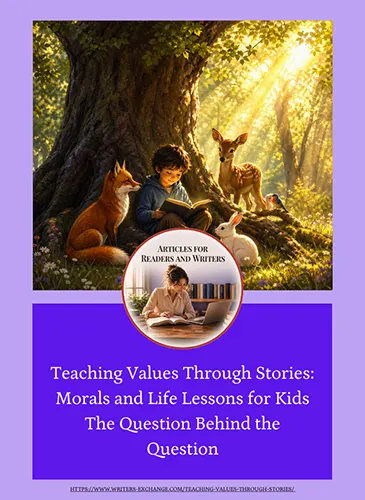
Ask a child what their favourite story is about, and they will almost never say "honesty" or "courage" or "kindness". They will tell you about a spider who saved a pig, a boy who got sent to bed without supper and ended up king of a wild kingdom, or four sisters making do while their father was away at war. The moral, if it exists at all in their awareness, is wrapped so tightly inside the story that the two things feel inseparable.
That is not an accident. It is the point.
Stories have always been how human beings pass down what matters. Long before formal schooling, before literacy, before written law, communities preserved their values in narrative: in fables and myths, in fireside tales, in the stories parents told their children at the end of the day. The specific form changes across cultures and centuries, but the underlying impulse does not. We reach for story when we want to say something important, because story is the only container strong enough to hold it.
This article looks at that process from two sides. For readers and parents, it examines what children actually receive from stories, how that emotional and moral learning happens, and why it works so much better than direct instruction. For writers of children's fiction, it explores what makes moral storytelling succeed or fail, and what distinguishes a story that leaves a lasting impression from one that simply delivers a lesson and moves on.
Why Stories Work When Lectures Do Not
The short answer is that stories get past the defences.
Children, like adults, resist being told what to think. The moment a lesson becomes obvious, something in the listener pulls back. It is not stubbornness exactly; it is a natural response to feeling managed. Direct moral instruction, however kindly intended, often triggers that response. A story does not. A story says, here is something that happened, and invites the listener to draw their own conclusions.
This is why Aesop's fables have survived for roughly two and a half thousand years. Aesop, credited as a slave and storyteller in ancient Greece around the sixth century BCE, gave his moral lessons to animals, keeping the instruction at one remove. "The Boy Who Cried Wolf" is not a lecture on honesty; it is a story about a shepherd boy, a village, and a wolf that eventually comes. The lesson follows naturally from the events. The reader arrives at it themselves.
That journey matters. Insights we reach ourselves feel different from insights we are handed. They carry a different kind of authority, because they feel earned rather than received. When a child watches a character make a bad decision and sees the consequences unfold, they are not being told that lying destroys trust. They are watching it happen, in real time, to someone they care about. The lesson sticks because it was experienced rather than explained.
There is also the question of emotional access. Abstract virtues like "integrity" or "compassion" mean relatively little to a six-year-old. But a child who has watched Charlotte the spider use her last strength to save Wilbur the pig knows something about loyalty and sacrifice that no definition could convey. E. B. White's Charlotte's Web, first published in 1952, does not ever say that friendship means putting someone else's needs above your own. It simply shows Charlotte doing exactly that, and lets the reader feel the weight of it.
The Reader's Experience: What Children Actually Take From Stories
The most important thing stories do for children is invite them into other lives. This is the foundation of everything else.
When a child reads, they are not merely observing a character from the outside. They are inhabiting them, to varying degrees, feeling what the character feels, seeing what they see, wanting what they want. Psychologists and reading researchers sometimes call this "narrative transportation", and it has real effects. Studies have consistently found that reading fiction increases empathy, partly because it gives people practice at experiencing the world from perspectives other than their own.
For children, this is particularly significant. A child who is naturally confident might not have any personal experience of being the new kid, lonely in a crowd. A story can give them that experience safely, from the inside. A child who has read about a character navigating social exclusion has, in some meaningful sense, been there. That experience shapes how they see and respond to similar situations in real life.
This is how stories teach values that children have not yet lived. The March sisters in Louisa May Alcott's Little Women, first published in 1868, face genuine hardship, family strain, and the everyday grind of trying to be good people in difficult circumstances. Their struggles with vanity, temper, and selfishness are not presented as failures but as the material of moral growth. A young reader watching Jo March wrestle with her ambitions and her family obligations is learning something real about what it costs to grow up.
Stories also create a kind of moral laboratory. Within the safe space of fiction, children can witness the consequences of choices without having to live them. They can see what happens when someone chooses cruelty over kindness, honesty over convenience, courage over self-protection, and they can begin to form their own sense of what kind of person they want to be. This is far more powerful than being told what the right choice is, because it engages judgment rather than compliance.
The conversations stories open up matter too. A child who has just read a story about a character facing a moral dilemma is primed to think about it. The right question from a parent or teacher, asked at the right moment, can take that thinking deeper. "What would you have done?" is a more interesting question than "what should you do?", and it is the story that makes the first question possible.
What Stays, and Why
Not every children's book that attempts a moral leaves much of an impression. Some are forgotten within a week. Others are read again and again across a childhood, and the images and feelings they created last for decades. The difference is almost never about the quality of the moral itself. It is about whether the story is actually any good.
A story that works is one where the reader genuinely cares what happens. The moral dimension of Charlotte's Web lands with such force precisely because Charlotte and Wilbur are completely real on the page. White is a precise and unsentimental writer. The farm in the book is a real farm, with all its biological messiness and its casual cruelties alongside its warmth. Charlotte is a spider, not a metaphor; she catches and eats insects, she is biologically specific, and she is also wise, funny, and completely devoted to her friend. That combination of the literal and the tender is what gives the book its power. The ending does not just illustrate a lesson about friendship; it breaks your heart, and you remember it.
Maurice Sendak's Where the Wild Things Are, published in 1963, demonstrates the same principle from a different angle. The book is barely ten sentences long. It contains no explicit moral whatsoever. And yet it has been speaking to children about anger, imagination, and the safety of home and love for over sixty years. It works because Sendak trusted children enough to show them something true: that big emotions are real, that they can be frightening, that you can live through them and come back. The moral is not stated. It is embodied in the journey Max takes and the supper that waits for him when he returns.
This is what the best children's books do. They do not explain what they mean. They mean it, directly and without apology, through the specific weight of the story they tell.
The Writer's Challenge: Earning the Lesson
Writing a values-driven children's story is one of the more technically demanding things a writer can attempt. The goal is to embed a moral in a narrative so thoroughly that the two are indistinguishable, and to do it without the reader (or their parents) ever feeling like they are being instructed. Get the balance wrong in either direction and the story collapses.
The first and most common failure is preachiness. A preachy story is one where the moral keeps asserting itself over the narrative, where the story pauses to deliver its message rather than letting the message emerge from events. Children are acutely sensitive to being talked down to, and a story that moralises at them will be put down, sometimes literally. The instinct to state the lesson is understandable; writers who care about their values want to make sure readers catch them. But the act of stating them is exactly what kills their effect.
The solution is to trust the story entirely. If a character is brave, the writer's job is to create a situation in which bravery is genuinely required and genuinely costly, and to show the character doing it anyway. The reader will understand what courage means not from being told, but from having watched it happen. This is what is really meant by the craft principle of showing rather than telling, which sounds simple and is not: it means constructing situations with enough specificity and emotional stakes that the value becomes visible through action, rather than assertion.
The second major challenge is characterisation. Moral stories fail when the character who embodies the lesson is too virtuous to be believed. A child who is always kind, always patient, always wise, is not a child; they are a diagram. Readers, including young ones, require characters who are flawed and recognisable, who make mistakes and feel things that are not particularly admirable, and who grow through the story rather than arriving already grown. The moral weight of a story is proportional to how much the character has had to struggle to arrive at it.
This is why Max in Where the Wild Things Are is a boy who is genuinely naughty at the start. He is sent to bed without supper for a reason. The comfort and resolution of the story depend on him having been genuinely wild first. And it is why the March sisters work so well: Alcott gives each of them specific, recognisable flaws, and the reader watches each one work against her own nature over the course of the book. The moral growth is hard-won, and that is what makes it real.
The third challenge is plot integration. The moral lesson needs to be embedded in the architecture of the story, not added as an afterthought. If the lesson could be removed without affecting the plot, it is not truly part of the story at all. In a well-constructed narrative, the character's moral journey and the external plot are the same journey. What the character needs to learn is precisely what the events of the story force them to confront.
Aesop understood this at the level of pure structure. Each fable is constructed so that the moral emerges inevitably from the sequence of events. There is no gap between "what happened" and "what it means". The story and the lesson are the same thing, which is why the fables are so memorable and why so many of them are still being read after two and a half millennia.
Characters Who Are More Than Their Lesson
One of the most useful exercises for a children's writer is to ask, of each major character: what does this person want that has nothing to do with the lesson? A character whose only function is to embody a virtue or illustrate a failing is not a character; they are a device. The moment they start wanting things for their own reasons, the moment they have an interior life that exists independently of the story's moral agenda, they become real.
This is one of the reasons that non-human characters have been so central to children's moral fiction throughout history. Animals, talking objects, fantastical creatures: these figures allow a kind of imaginative distance. Charlotte is a spider with her own biological reality, her own voice, her own sardonic wisdom. The Giving Tree, first published by Shel Silverstein in 1964, presents its central relationship entirely through a tree and a boy, allowing the reader to bring their own interpretation to what is in many ways an ambiguous moral situation. The animal fable tradition that Aesop established persists because it gives moral questions room to breathe.
The distance also allows writers to be honest in ways that might otherwise feel too direct or too painful. A story about a child who makes a terrible mistake and has to live with the consequences might be too close to the bone for some young readers if told with human characters. The same story told with animals creates enough separation that the reader can engage with it fully.
The Role of Consequences
Moral storytelling lives or dies on consequences. If a character can lie, or be cruel, or act selfishly, without any meaningful outcome, the story is not teaching anything. It is simply describing behaviour.
The consequences do not need to be dramatic. They do not need to be punishments. In the best moral fiction, they are simply the logical results of the choices the character makes, and the reader watches them unfold naturally. The shepherd boy in "The Boy Who Cried Wolf" is not struck down by lightning for his dishonesty. He loses something more fundamental: the trust of the people around him, at the moment he most needs it. The consequence is real, proportionate, and inevitable, and that is what gives it weight.
It is worth noting that consequences can also be positive. A character who chooses kindness over convenience, who is honest at personal cost, who chooses to help when it would be easier not to, can experience outcomes that feel earned and genuine. The moral is not only "this is what happens when you do wrong". It is equally "this is what becomes possible when you do right". Children need both kinds of story.
Darkness, Difficulty, and Honesty
One of the most persistent misunderstandings about children's fiction is that it should protect children from difficulty. The most enduring children's books do exactly the opposite. They take difficulty seriously. They do not lie about loss, or pretend that good choices are always rewarded, or suggest that the world is simpler than it is.
Charlotte dies. That is a fact of the book, not a flaw in it. It is what gives the story its true moral weight. A friendship story in which nobody is ever at risk of loss is not really a friendship story at all; it is a reassurance exercise. White trusted his young readers enough to tell them the truth about what friendship means and what it costs, and generations of children have been grateful for it, even when they cried.
Sendak faced significant resistance when Where the Wild Things Are was published, with some critics arguing that the dark imagery would frighten children. He was unmoved. He understood, correctly, that children already know fear and anger; what they need is not to be protected from those feelings but to have them acknowledged and given form. A story that tells a child their big feelings are real, that they can survive them, and that there is love waiting on the other side, is doing something important.
This is the honesty that children's moral fiction requires. Not the honesty of spelling everything out, but the honesty of taking children's emotional reality seriously and not flinching from what it contains.
Practical Notes for Writers
Several craft principles follow from what has been discussed, and they are worth stating plainly for writers approaching this kind of work.
Write the character first, the lesson second. If you begin with a lesson and build a character to carry it, you will almost certainly produce a character who feels thin. Begin instead with a fully imagined person, animal, or creature, who has desires, fears, and flaws that exist independently of any moral purpose, and then put them in a situation that genuinely tests them. The lesson will emerge from who they are and what they do.
Make the stakes real. If the character has nothing to lose, there is no story. The difficulty of the choice, or the cost of the mistake, is what gives the moral dimension its weight. Bravery in a story where nothing is scary means nothing. Honesty that costs nothing teaches nothing.
Resist the explicit. The moment you find yourself writing a line that states the lesson, treat it as a warning sign. It almost always means the story has not yet done the work of earning it. Cut the statement and find a scene or moment that makes the reader feel what the statement was trying to say.
Trust the reader. Children are perceptive, and they resent condescension. A story that explains itself too thoroughly, that holds the reader's hand through every emotional beat, is a story that does not believe in its own audience. Leave room for the reader to bring something of their own.
A Note on Reading Together
For parents and educators, the most powerful thing a story can offer is not a lesson delivered, but a conversation opened. A child who has just finished a book with a moral dimension is holding something in their mind that they are often ready to think about further, if invited. The best conversations about values do not begin with "what did you learn?" but with "what was the most surprising thing?" or "was there a moment where you thought the character might choose differently?" These questions treat the child as a thinking person rather than a recipient of instruction, and the discussions they open are often far more rich and lasting than anything the book alone can provide.
The tradition of reading aloud to children, and discussing what is read, is not separate from the tradition of moral storytelling. It is the completion of it. The story creates the opening; the conversation between a child and a trusted adult is where the real thinking happens.
What Endures
The stories that have lasted longest are not the ones with the clearest lessons. They are the ones that were most honest about what it is to be alive and growing, most willing to take children's inner lives seriously, most trusting of their capacity to feel and to understand.
Charlotte's Web is a book about death and friendship, written without sentimentality or evasion. Little Women is a book about the cost of becoming who you are in a world that keeps telling you who you should be. Where the Wild Things Are is a book about the ferocity of childhood feeling and the quiet miracle of unconditional love. None of these books is primarily "about" its moral. They are about people, and the values they embody emerge from the people being fully real.
That is the standard for writers of children's fiction: not "does this teach a good lesson?" but "is this true?" A story that is true, in the sense of being honest about human experience, will teach what needs to be taught without ever having to try. And it will be remembered long after any number of more instructive but less living books have been forgotten.