










What Allegory Actually Does
Christian literature has always done something more than tell stories. At its best it has used story to carry spiritual weight that argument alone cannot bear, presenting truths about faith, sin, redemption, and grace in forms that bypass intellectual resistance and lodge somewhere deeper. The vehicle for much of this work is allegory: a sustained narrative mode in which characters, events, and settings operate on two levels at once, the literal and the symbolic, each supporting the other.
The word allegory has become so familiar that it is easy to mistake what makes it powerful. An allegory is not simply a story with a moral. It is a structure in which the literal surface is designed to generate meaning beyond itself: where the journey is also a spiritual journey, where the stranger's challenge is also the challenge of conscience, where the bird that rises from its own ashes is not just a remarkable creature but an image of resurrection. The two levels have to hold together with internal consistency; a lazy allegory that only fitfully connects its surface to its depths will not sustain a reader's imaginative engagement.
This article looks at four texts from across the Christian literary tradition that do this work well: the Song of Solomon from the Hebrew scriptures, the Old English poem The Phoenix, the medieval English poem Sir Gawain and the Green Knight, and C.S. Lewis's The Lion, the Witch and the Wardrobe. Together they span roughly three thousand years of Christian allegorical imagination. Each is interesting for different reasons, not least because each handles the relationship between surface and meaning in a distinct way.
The Song of Solomon: When Love Becomes Theology
The Song of Solomon, known also as the Song of Songs, is one of the stranger books of the Hebrew Bible. It is a collection of love poetry, erotic in places, lyrical throughout, celebrating the desire and longing between a woman and a man. There is no direct mention of God. No law is given, no prophecy delivered, no theology argued. And yet it sits in the canon, and has been read by Jewish and Christian interpreters for centuries as one of the most spiritually charged texts in scripture.
The allegorical reading, which developed early in both traditions, understands the love between the woman and her beloved as a figure for a higher love: in Jewish interpretation, between God and Israel; in Christian tradition, between Christ and the Church, or between Christ and the individual soul. The third-century theologian Origen wrote an extensive commentary on this text, treating it as a profound exploration of the soul's longing for union with the divine. Bernard of Clairvaux, writing in the twelfth century, preached eighty-six sermons on the Song of Solomon and never reached the end of it; the text seemed to him inexhaustible as a meditation on spiritual love.
The verse "I am my beloved's and my beloved is mine" (Song of Solomon 6:3, NASB) concentrates this allegorical possibility in nine words. The mutual belonging described, not possession but a reciprocal claim that goes both ways, becomes, in the allegorical reading, an image of the covenant relationship between the believer and God. The longing that runs through the book, the searching in the night, the brief meetings and withdrawals, the ache of separation, all become figures for the spiritual life as the tradition has understood it: a movement of desire toward a God who is intimately present yet always beyond full grasp.
What makes this a rewarding case for readers is that the allegorical and the literal are not competing. You do not have to discard the love poem to find the theology; the theology is present precisely because the love poem is doing its work so well. The spiritual reading depends on the emotional intensity of the surface. A flat or clinical account of love would not generate the allegorical resonance that has made this text sustain centuries of commentary.
The Phoenix: Death, Rebirth, and the Shape of Christian Hope
The Phoenix is an anonymous Old English poem of 677 lines, preserved in the Exeter Book manuscript. It takes as its source a fourth-century Latin poem, De Ave Phoenice, usually attributed to the early Christian writer Lactantius, though scholars continue to debate that attribution. The Latin source is a description of the mythical phoenix: a bird of extraordinary longevity that builds its own funeral pyre, is consumed in flame, and rises reborn from the ashes.
The Old English poet takes this material and explicitly Christianises it. The second half of the poem draws out the allegorical significance: the phoenix's death and renewal becomes an image of the resurrection of Christ, and by extension an image of the spiritual renewal available to believers through faith. As one scholar from Springer Nature's academic journal Neophilologus has noted, the poem "describes the mythical bird, the Edenic landscape it inhabits and the cycle of death and rebirth that it enacts in an extended Christian allegory."
The allegory works in part because the phoenix myth already carried resurrection overtones in the wider culture. The phoenix was a recognised symbol of renewal in pagan antiquity. What the Christian poet does is not invent the symbolism but claim it, redirecting a pre-existing image toward a specifically Christian meaning. This is a strategy early Christian writers used frequently: taking images, stories, and even philosophical frameworks from the surrounding culture and reading them as preparations for or shadows of the gospel.
For readers interested in how allegory operates, The Phoenix shows the technique in a relatively transparent form. The poem first builds the literal description in rich detail, then turns explicitly to explain its meaning. This two-part structure, story then interpretation, is close to the way a parable works. For writers, it illustrates that allegorical meaning does not need to be hidden or subtle; what matters is that the literal level is vivid enough to earn the reader's attention before the symbolic register is engaged.
Sir Gawain and the Green Knight: Honour, Failure, and the Need for Grace
Sir Gawain and the Green Knight is a late fourteenth-century Middle English poem of extraordinary sophistication, written by an anonymous poet in a North West Midlands dialect. The story is deceptively simple: a mysterious Green Knight appears at King Arthur's court and proposes a beheading game. Sir Gawain, the most junior of the knights, accepts the challenge, beheads the Green Knight with one blow, only to watch, horrified, as the knight picks up his own severed head and rides away, reminding Gawain to seek him out in a year for the return blow.
The journey to meet the Green Knight takes Gawain through a winter landscape, to a castle where he is generously hosted by a lord and his wife. The wife attempts to seduce him on three successive mornings. Gawain, wearing a shield bearing the image of the Virgin Mary, resists the seductions of the flesh, but accepts from the lady a green girdle she claims will protect him from death. He conceals this from his host, breaking the terms of an exchange-of-winnings game they have agreed upon. At the Green Chapel, the Green Knight, who turns out to be the lord in disguise, reveals he has been testing Gawain. He gives him a light nick on the neck rather than a killing blow, acknowledging Gawain's essential virtue while identifying the one moment of failure: the hidden girdle, the small act of self-preservation that cost him his complete honesty.
The poem has attracted allegorical readings for generations, though scholars are careful to note that no single allegorical key unlocks it entirely. The girdle, that green silk band, becomes a rich symbol: a sign of Gawain's wavering faith, his preference for a magical talisman over trust in God. As scholars at eNotes.com note, "his acceptance of the green girdle, intended to preserve his life, ultimately symbolizes his fear and a wavering faith." The Green Knight's role as judge who nevertheless extends mercy, who delivers a wound rather than a death, who acknowledges imperfection while offering redemption: these elements have led some interpreters to read the figure as suggesting the role of Christ in the economy of grace, though this is one scholarly reading among several and the poem resists any single totalising interpretation.
What the poem most clearly allegorises is something all its readers recognise: the predicament of a person who is genuinely trying to be good, who succeeds almost entirely, and who fails at the one point where self-preservation felt more urgent than principle. The poem's conclusion is notable for what it does with this failure. Gawain's court receives him not with condemnation but with a kind of wry solidarity; everyone agrees to wear a similar green girdle in his honour, transforming his emblem of shame into a shared acknowledgement that all of them would likely have done the same. The allegory here is not of failure alone but of failure met with grace, which is a rather more interesting theological point.
The poem also illustrates something important about how Christian allegory operates in literary tradition. It does not require the author to have planned a systematic symbolism. The Christian imagery is woven into the texture of the poem; the liturgical calendar structures the narrative, the Virgin's image appears on the shield, confession and penance figure explicitly in the story. These elements do not combine into a tidy scheme, but they do create an atmosphere in which questions of sin, grace, and redemption are perpetually in the air.
C.S. Lewis and the Problem of Allegory
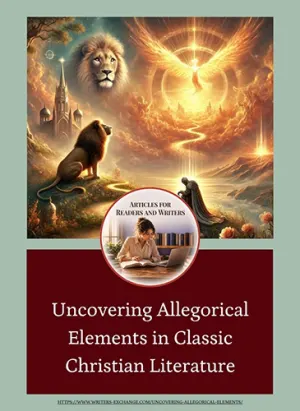
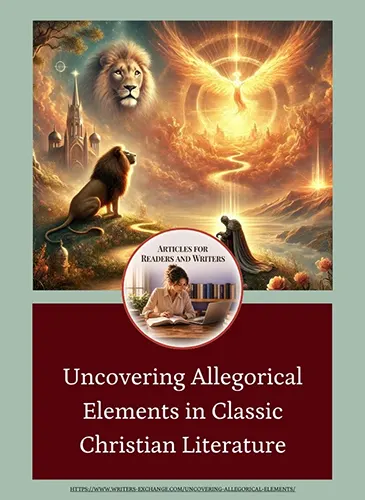
The Chronicles of Narnia is the most widely read body of Christian allegorical fiction in the modern era, and it raises one of the most interesting questions in this entire discussion: what exactly is allegory, and is Narnia actually doing it?
Lewis himself was insistent that Narnia was not allegory. He had written a major academic study of medieval allegory, The Allegory of Love, and knew the distinction precisely. In a December 1962 letter to a Mr. Higgins, he wrote: "The Narnian books are not as much allegory as supposal. 'Suppose there were a Narnian world and it, like ours, needed redemption. What kind of incarnation and Passion might Christ be supposed to undergo there?'" In other writings he was still more direct: "If Aslan represented the immaterial Deity in the same way in which Giant Despair represents Despair, he would be an allegorical figure. In reality however he is an invention giving an imaginary answer to the question, 'What might Christ become like if there really were a world like Narnia and He chose to be incarnate and die and rise again in that world as He actually has done in ours?' This is not allegory at all."
The distinction matters for readers and writers alike. In a traditional allegory such as Bunyan's The Pilgrim's Progress, each character and event represents something specific and extractable: Christian is the Christian soul, the Slough of Despond is the experience of despair, Doubting Castle is the spiritual condition of doubt. There is a one-to-one relationship between story and meaning. Lewis's Narnia works differently. Aslan is not a representation of Christ; he is, in Lewis's conception, what Christ himself might actually be like in a world where lions are the noblest creatures and redemption is required. The story is not about something else; it is itself an instance of the thing it appears to depict.
This distinction only sharpens the resonance of The Lion, the Witch and the Wardrobe (published by Geoffrey Bles in 1950) for readers who do have Christian commitments. Edmund's treachery, his enslavement to the White Witch's Turkish Delight, his inability to free himself, and his ultimate rescue not through his own heroism but through Aslan's willing sacrifice on the Stone Table: these events do not symbolise the Christian account of sin and redemption; they enact a version of it. Aslan is killed on the Stone Table, which he explains is broken by a "deeper magic from before the dawn of time" when an innocent victim dies in a traitor's place. The Stone Table itself, scholars have noted, suggests the Mosaic Law, which breaks when the new covenant of grace supersedes it.
For Christian readers, the effect Lewis described is real: encountering these truths not through direct instruction but through imaginative experience, "stripping them of their stained-glass and Sunday school associations," as he wrote, allows them to arrive with unexpected force. For readers with no particular theological commitment, the story still works as a narrative of betrayal, sacrifice, and forgiveness, the universal elements of the structure remain intact.
What These Texts Teach Writers
For writers working in the Christian tradition, or indeed for any writer drawn to narrative with symbolic depth, these four texts together suggest a few principles worth holding onto.
The first is that allegory requires a convincing literal level. The Song of Solomon works as allegory because it is first an arresting love poem. The Phoenix works because the description of the bird is vivid and strange before the interpretation begins. Gawain works because the human drama of a good man navigating an impossible situation is immediately compelling. Narnia works because Aslan is a genuinely terrifying and magnificent lion, not a theology in a lion costume. If the surface story is thin, the symbolic meanings will feel forced and the reader will resist rather than receive them.
The second is that the best allegorical Christian fiction tends to locate its symbolic weight in human experience rather than in abstract doctrine. It is not that Lewis decided to embody the concept of substitutionary atonement in narrative form; it is that the story of a guilty person rescued by someone innocent choosing to die in their place is one of the most powerful story shapes in human experience. The Christian theological account names what that story points toward. Allegory is not illustration of doctrine; it is story that participates in the same reality that doctrine attempts to describe in propositional language.
The third is that honest allegory does not flatten moral complexity. Sir Gawain's failure is treated with complete seriousness; so is his virtue. The Song of Solomon does not sanitise longing into something merely decorative. The Phoenix's description of the bird's death is not softened to make the resurrection easier. Lewis's Edmund is genuinely culpable, the White Witch genuinely frightening, Aslan's death genuinely terrible. The allegorical register deepens in proportion to the moral and emotional honesty of the narrative surface.
What These Texts Give Readers
For readers who come to these texts without writing ambitions, there is something equally important to take away. Allegorical literature is not a puzzle to be solved, where the reward is extracting the hidden meaning and leaving the story behind. The two levels are meant to work together, each enriching the other.
Reading the Song of Solomon as both a love poem and a spiritual text is not a matter of choosing one frame and discarding the other. It is a matter of allowing the two to illuminate each other: the love poem shows what spiritual longing feels like from the inside; the theological frame shows what the human experience of love points toward beyond itself.
Reading Sir Gawain in its Christian context does not reduce the poem to a parable about confession and penance. It widens it. The medieval reader would have felt the full weight of Gawain's failure and the full measure of the grace that received him back, not as abstract ideas but as lived realities they knew from their own experience of the Christian life. The poem used story to make those realities present and tangible.
And reading Lewis's Narnia with Lewis's own account of what he was doing: not allegory but supposal, not representation but imaginary enactment, opens the possibility of encountering the Christian story freshly, without the armour of familiarity or the resistance of prior argument. He described his intention as stealing past the "watchful dragons" that prevent people from feeling what they know. After three thousand years of Christian allegorical imagination, that remains as good a description of the enterprise as any.