










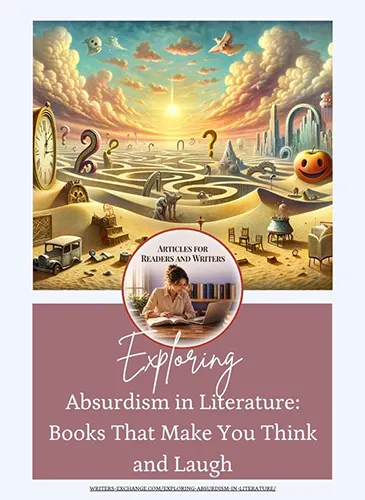
There is a particular kind of writer who looks at the human condition, sees its fundamental strangeness, and laughs. Not from ignorance or cruelty, but from recognition. Absurdist literature is built on this laugh: the laugh that comes when you realise the universe has no interest in your questions, will provide no answers, and yet here you are, alive and asking anyway. Far from being a philosophy of despair, absurdism is one of the more defiant and life-affirming traditions in all of literature, and the works it has produced, from Camus's devastatingly spare novels to Douglas Adams's cosmic farce, remain among the most bracing reading experiences on offer.
The Philosophy: Not Meaninglessness But Conflict
The word "absurdist" is often used loosely to mean "strange" or "darkly comic", but the tradition it names has a specific philosophical foundation. Albert Camus laid it out most precisely in The Myth of Sisyphus, published in 1942. The absurd, for Camus, is not simply the claim that life is meaningless. It is something subtler and more interesting: the absurd is the clash between the human need for meaning and the universe's complete silence on the matter. As Camus wrote, "Man stands face to face with the irrational. He feels within him his longing for happiness and for reason. The absurd is born of this confrontation between the human need and the unreasonable silence of the world."
The distinction matters because it changes what absurdism is actually saying. A philosophy that simply declares life meaningless leaves you with nowhere to go. Camus's absurdism, by contrast, identifies a condition, names it honestly, and then insists on living anyway. His famous response to the absurd was not suicide (which he rejected as a surrender) and not a leap of religious faith (which he saw as another kind of evasion). It was revolt: a clear-eyed, passionate engagement with existence that refuses to pretend there are answers where there are none. The image he used was Sisyphus, condemned by the gods to roll his boulder up a mountain for eternity, only to watch it roll back down. Camus's verdict: "The struggle itself toward the heights is enough to fill a man's heart. One must imagine Sisyphus happy."
It is worth noting that Camus actively resisted being categorised as an existentialist, despite his frequent association with Sartre and other post-war French thinkers. The distinction is real: existentialism, in Sartre's version, tends to create meaning through choice and commitment. Camus's absurdism refuses even that consolation. The universe offers nothing, choice creates nothing permanent, and yet the act of living is itself the point. This refusal to flinch, combined with a deep humanist warmth, is what gives the best absurdist literature its particular flavour.
Before Camus: Kafka and the Literary Groundwork
If Camus provided the philosophical vocabulary, Franz Kafka showed writers what absurdism could look like on the page. Kafka was born in Prague in 1883 and died in 1924, before publishing any of his major novels himself. His short story The Metamorphosis appeared in 1915, and The Trial was published posthumously in 1925 from a manuscript he had written a decade earlier. Kafka never used the word "absurdism" and would have resisted any label, but his work anticipates the tradition in ways that still feel startling.
In The Metamorphosis, travelling salesman Gregor Samsa wakes to find himself transformed into a large insect. The story proceeds not as horror or fantasy but as a kind of deadpan domestic crisis: Gregor's first concern is that he will be late for work. The bureaucratic anxiety, the family's practical inconvenience, the protagonist's bewildered acceptance of a situation that defies all rational explanation, these are the building blocks that Beckett and Ionesco would later work with. In The Trial, Josef K. is arrested for an unspecified crime by an unspecified authority, and spends the entire novel trying to understand a legal system that has no interest in being understood. The term "Kafkaesque" entered the language to describe precisely this experience: the nightmare of institutions that resist comprehension while demanding compliance.
Kafka matters to the absurdist tradition because he demonstrated that you could render the fundamental irrationality of existence without allegory, without explanation, and without resolution. His characters simply live in a world that doesn't make sense, and the reader is left to feel the full weight of that.
The Theatre of the Absurd
The dramatic tradition that critics eventually labelled the Theatre of the Absurd emerged in Paris in the early 1950s, primarily through the work of Eugene Ionesco and Samuel Beckett. Ionesco's The Bald Soprano premiered on 11 May 1950, a play in which two bourgeois English couples hold conversations that unravel into pure nonsense and repetition, the social conventions of ordinary speech exposed as hollow performance. It is both very funny and genuinely unsettling.
The critic Martin Esslin gave the movement its name in a 1960 essay and the 1961 book that followed, identifying a shared sensibility among Beckett, Ionesco, Jean Genet, Arthur Adamov, Harold Pinter, and others. What united them was a formal commitment that matched their philosophical content: instead of plays with clear arguments and resolutions, these writers built structures that enacted meaninglessness directly, through circular dialogue, absent or inexplicable plots, characters unable to communicate, and situations that refused to resolve.
Waiting for Godot: Nothing Happens, Twice
Waiting for Godot, written by Samuel Beckett in French between 1948 and 1949 and first performed on 5 January 1953 at the Théâtre de Babylone in Paris, is the work most people think of when they hear the phrase Theatre of the Absurd. In a 1998 poll of more than 800 theatre professionals conducted by the UK's Royal National Theatre, it was voted the most important English-language play of the twentieth century. The difficulty is describing why.
Two men, Vladimir and Estragon, wait by a tree for someone named Godot who never arrives. That is essentially all that happens. They talk, they argue, they contemplate suicide, they encounter two other characters, and they wait. The second act largely repeats the first with minor variations. The Irish critic Vivian Mercier captured it memorably when he wrote that Beckett "has achieved a theoretical impossibility, a play in which nothing happens, that yet keeps audiences glued to their seats. What's more, since the second act is a subtly different reprise of the first, he has written a play in which nothing happens, twice."
What makes the play work is precisely the humour that emerges from its own pointlessness. Vladimir and Estragon's dialogue is full of music-hall timing and comic misunderstanding. The play is funny in the way that genuine confusion is sometimes funny, when the gap between what we expect and what we get becomes wide enough to be laughable rather than merely painful. Beckett's genius was to make the audience feel both the comedy and the weight of it simultaneously. You laugh, and then you sit with what you laughed at.
The Stranger: The Absurd Man in Prose
Published in the same year as The Myth of Sisyphus, Camus's novel The Stranger is the fictional counterpart to his philosophy. The protagonist Meursault lives in French Algeria with a peculiar emotional detachment: he does not cry at his mother's funeral, pursues a romantic relationship the day after, and eventually kills an Arab man on a beach without any motive he can explain or that the narrative offers. At his trial, he is condemned as much for his emotional blankness as for the killing itself. He is found guilty, at least partly, of failing to perform the required social emotions.
Camus described Meursault in a preface as a man who "does not play the game", someone who refuses the convenient fictions by which society functions. The society finds this intolerable. But the novel's final pages, in which Meursault, facing execution, opens himself to "the gentle indifference of the universe" and finds a kind of peace, offer something that looks remarkably like Camus's Sisyphean revolt: not happiness in any ordinary sense, but the clarity that comes from accepting reality as it actually is.
The prose itself does much of the philosophical work. Camus's sentences are flat and immediate, drained of emotional colouring. Events are reported with the same weight as observations, which is to say, with no particular weight at all. Reading The Stranger is a genuinely strange experience because the prose keeps unsettling your assumptions about what matters and what doesn't, which is precisely the point.
Catch-22: The Absurdity of Institutions
Joseph Heller's Catch-22, published in October 1961 by Simon and Schuster, takes the absurdist tradition into the institutional world of the American military during World War Two. Its protagonist, Captain John Yossarian, is a bombardier who wants desperately to stop flying dangerous missions and go home. The obstacle is the Catch-22 of the title: anyone who is insane can be grounded, but asking to be grounded is evidence of sanity, since only a sane person would recognise the danger of flying. Anyone sane enough to ask is therefore sane enough to keep flying. The trap has no exit.
Heller's non-linear narrative, jumping between episodes without respect for chronology, gives the novel a structure that mimics the logic of its institutions. Rules contradict rules. Regulations exist to produce more regulations. Authority figures pursue objectives that have nothing to do with the war and everything to do with self-interest, self-advancement, or pure abstraction. Yossarian's sanity, his ordinary desire to stay alive, makes him the most subversive figure in the book: the one person who takes the stated goals of the institution seriously enough to notice that the institution itself has abandoned them.
What makes Catch-22 more than satire is that the comedy and the tragedy are inseparable. The novel is very funny, with a rich cast of characters whose individual absurdities accumulate into a picture of a world in which coherent purposes have simply ceased to function. But the funniest episodes often pivot without warning into something devastating. The novel's later chapters, as the deaths of minor characters from earlier sections are revisited with their full weight, are among the most painful in American literature. Heller had understood that absurdism is not a distance from suffering but a particular way of holding it.
The Hitchhiker's Guide to the Galaxy: Cosmic Scale
Douglas Adams published The Hitchhiker's Guide to the Galaxy in October 1979, adapted from a BBC Radio 4 comedy series he had written the previous year. The premise is thoroughly absurdist: Earth is demolished to make way for a hyperspace bypass, seconds before which Arthur Dent, an ordinary Englishman in his dressing gown, is whisked off the planet by his friend Ford Prefect, who has spent the last fifteen years posing as an out-of-work actor while actually being a researcher for the in-universe Hitchhiker's Guide.
Adams extends absurdism to a genuinely cosmic scale. The book's most celebrated device involves a supercomputer called Deep Thought, built to answer the Ultimate Question of Life, the Universe, and Everything. After 7.5 million years of computation, it announces that the answer is 42. The problem is that no one can remember what the Question was. Adams himself said the joke had no deeper meaning: "It was a joke. It had to be a number, an ordinary, smallish number, and I chose that one." But the joke lands because it captures something philosophically precise. Humanity has been asking what the answer is without knowing what the question is. Deep Thought's 42 is the universe's equivalent of the reasonable silence Camus described: there is an answer, it is just completely useless to you.
Adams's particular contribution to the tradition is a comedy of scale. The universe in his fiction is not merely indifferent, it is specifically inconvenient, bureaucratically obstructive, and possessed of a kind of cosmic bad timing. Arthur Dent stumbles through events of galactic significance while never quite understanding what is happening or why it keeps happening to him. The comedy comes from the mismatch between the scale of events and the resolutely ordinary consciousness observing them, which turns out to be an excellent location for the absurdist sensibility.
Rosencrantz and Guildenstern Are Dead: The View From the Margins
Tom Stoppard's Rosencrantz and Guildenstern Are Dead was first performed at the Edinburgh Festival Fringe on 24 August 1966 by the Oxford Theatre Group, entered the repertory of the National Theatre in 1967, and established Stoppard as one of the most important playwrights of his generation. The play takes two minor characters from Shakespeare's Hamlet, childhood friends who appear briefly to spy on the prince and are then dispatched to their deaths offstage, and places them at the centre.
The play opens with Rosencrantz winning ninety-two consecutive coin tosses, all heads. Guildenstern tries to reason his way to an explanation and cannot. The coin keeps landing heads. The randomness of the universe is established before a word of plot has been spoken. From there, the play proceeds as a meditation on what it is like to be minor characters in a story whose shape you cannot see: summoned without explanation, given instructions you don't understand, moved towards an ending you cannot prevent.
Stoppard's debt to Beckett is explicit, both structurally and in the texture of the dialogue. Like Waiting for Godot, the play is built around two characters passing the time in the face of unknowable larger forces. But Stoppard adds a specifically intellectual dimension, an almost Baroque delight in paradox, wordplay, and the limits of language itself. The result is a play that is simultaneously funnier than Beckett and more openly playful, while reaching for the same underlying recognition: that we are all, in some fundamental sense, minor characters in events whose meaning we cannot access from where we stand.
Why the Tradition Holds
What unites these works, across the decades and genres and tonal registers that separate them, is a refusal of two easy exits. Nihilism says nothing matters, and stops there. Religious consolation says everything matters because meaning comes from beyond. Absurdism takes the harder route: it agrees with nihilism about the state of the universe and then disagrees completely about what follows. Life is what you make of it precisely because the universe won't make anything of it for you.
The laughter in absurdist literature is not the laughter of cruelty or contempt. It is the laughter of recognition, of finding your own bewilderment suddenly named and shared. When Yossarian rages against the logic of Catch-22, when Vladimir and Estragon discuss philosophy while waiting for someone who will never come, when Arthur Dent asks for a cup of tea at the end of the universe and is told the machine doesn't do tea, you laugh because you recognise the experience. You have been there: not necessarily at the end of the universe, but in the presence of an indifferent system, or an unanswerable question, or a situation that would be funny if it weren't happening to you.
The best absurdist literature invites you to find it funny that it is happening to you. That invitation, accepted often enough, becomes a way of inhabiting the world. Not with false cheerfulness, not with resignation, but with the kind of clear-eyed tenacity that Camus had in mind when he imagined Sisyphus, descending the mountain again, and happy.