












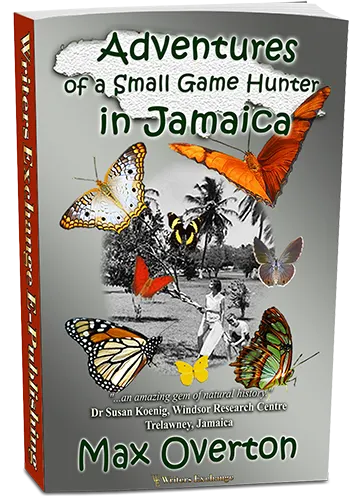
Adventures of a Small Game Hunter in Jamaica by Max Overton
Eleven-year-old Max is pulled from boarding school in England and delivered, with barely five minutes' warning, to the tropical island of Jamaica. He has never seen anything like it: hummingbirds that blur into invisibility, lizards that hiss from tree trunks, scorpions under every rock, and butterflies beyond anything he could have imagined.
Armed with a handmade net and a growing obsession, Max throws himself into Jamaica's wild places. He haunts the butterfly cabinets of Kingston's Institute of Jamaica, cycles Hope Road scanning for rarities, and convinces his father to drive him to cloud-shrouded mountain passes, dusty Cockpit Country tracks, and remote forest clearings, all in pursuit of creatures that constantly elude him.
Above all, he chases the Homerus swallowtail. Papilio homerus: Jamaica's largest butterfly and the largest in all the Americas. He sees it three times. He never catches it.
The butterflies in Max Overton's collection are now more than fifty years old, their colours faded, their wings tattered. But every one of them holds a story: the thrill of the chase, the sting of failure, and the discovery that some prizes are worth more uncaught.
Also Available from these Retailers:







📖 Read the first chapter!
Preface
A bearded man with
dreadlocks stepped out in front of me shaking his fist as I swerved my bicycle
to avoid him.
"White man blood and fire!" he called after me as
I pedalled away.
This memory popped unbidden into my
mind the other day, more than fifty years after the event, and brought with it
a flood of other memories from my youth. I went to my stored butterfly
collection and opened up the two boxes that house all I have left of my
butterflying days in the Caribbean.
Memories fade and warp with time but looking at my small
collection of Jamaican butterflies, caught between the years of 1959 and 1961,
when I had the extreme good fortune to live in Jamaica, that beautiful
Caribbean island, I remembered many other things I thought I had forgotten. I
realised then, as I examined my faded and tattered specimens that have followed
me from house to house and country to country, that each one had the potential
to tell a story. As I considered my collection, many of those stories came back
to me, some in great detail, and some with no more than a place, a date, and
the old muscle memory of the swing of a butterfly net.
I am an only child and both my parents are dead, so I am the
only person now living with memories of the Overton family in Jamaica, and
unless I write them down, they will vanish with me. I don't believe that my
memories have any great historical significance, but they may be of interest to
my sons and grandchildren (six grandchildren and step-grandchildren at the time
of writing). These stories are more for them than the general public, though
other people may be interested in what an eleven- to thirteen-year-old boy
could do in a vanished time and a gentler land. I know I would not let my own
children get up to half of what I got up to, wandering alone in a foreign
country.
These are stories of butterfly collecting and a few other
escapades of a young boy--nothing startling, but all basically true. I have had
to refresh my memory in places from old snapshots, tattered maps, and the
information pinned beneath my specimens. For the most part, dialogue has had to
be invented, and serves to lubricate descriptions of places and events. I, and
others, may not have said exactly the words reported here, but we said
something very like them, at those times. The chapters don't necessarily follow
on, one from another, but can instead be viewed as a series of snapshots, each
connected to a particular butterfly or memory.
I have added pictures of some of these butterflies at the
end of the book. I make no apologies for the condition of the specimens. They
are the product of a small boy's enthusiasm, and I lacked proper setting boards
and entomological pins. If they look skewed and tattered, that is my own fault,
but their inclusion, I hope, will give my stories more meaning. I think I have
made the correct identifications, but there is often some doubt with groups of
butterflies that look alike.
I have taken a small dipper to a large well, and drawn up no
more than sips of memory. I spent about twenty-seven months in Jamaica and was
busy most of the time doing boyish things. I went to school, played with
friends, interacted with my family, but I lived for my butterfly collecting,
and a lot of my sips reflect my passion. I cannot hope to relate everything
that happened to me but I hope these words will offer a taste of what life was
like for a small game hunter in Jamaica.
Oh, one other thing...memory is a strange beast and a
sometimes elusive one. It is not above presenting itself as something quite
different from the facts. False memory comes into play, where one is sure
something happened when it is, in fact, quite impossible. I have one instance
of this in my stories of Jamaica, of catching a butterfly I am assured by
experts could not exist on the island--yet I remember catching it. I say a bit
more about this in the relevant place. So too, with the characters that populate
my stories. I remember the individuals well, and I would swear that I portray
them correctly within each story, but one of my friend's memories of events
differs from mine. What am I to make of that? Is his memory or mine faulty? All
I can reasonably do is tell the story as I remember it, but if he wants to tell
the story elsewhere in a different manner, I won't complain.
So, in the meantime, enjoy the recollections of a Small Game
Hunter in Jamaica.
Arrival
I was snatched out of
boarding school with no more than five minutes warning. I'm sure my parents
must have told me this would happen, but I honestly don't remember. We lived in
Düsseldorf, Germany at the time, and I went to boarding school in England--Thorpe
House Preparatory School for Boys in the little Buckinghamshire town of
Gerrards Cross. I went home for the Christmas holidays and my birthday, and
returned to school in mid-January. I had issues with Thorpe House and my
parents, not least of which was the feeling of abandonment by my mother when
she first took me there and left me, a six-year-old softie, to sink or swim in
a cruel environment. I hated school--or at least that school--so I think I did
not really believe my parents were about to liberate me from its confines. I
may have told someone I was leaving--I had a few friends there--but if I did I
don't remember.
I think it was a Friday morning--the last Friday in the
month--and I was sitting in class struggling to absorb a lesson on the
geography of the Midlands, when the school matron entered the class and went
over to the teacher Mr Wood. She whispered something and he looked at me.
"Overton. Put your books away and go with Matron."
"Sir?"
"Now, Overton. Your taxi's waiting."
I went, casting an apologetic look backward at the puzzled
faces of my school friends. I never saw them again, but I can remember some of
their names--Mugford, Young, Newton, the Jude brothers. I still have an
informal class photo that has us all in it and I sometimes wonder what became
of them. I was a dreamy child and I had possibly not told them I was leaving
for good.
On that day, the taxi took me to the railway station in
Gerrards Cross where my luggage and I were loaded aboard a train and sent off
to London. You might think that travelling alone as an eleven-year-old was a
risky venture, but times were different back then. It did not trouble me as I
had been commuting between England and Germany by air alone since I was eight.
I just followed instructions, held out my ticket, and waited for an adult to
tell me where to go. My mother met me at Marylebone Station and we boarded
another train for the trip to Southampton.
"Where are we going, Mum?" I asked.
"Max, we told you all this. We're going to Jamaica.
Your father retired from the army and has a job as manager of an insurance
company."
"Oh." I thought about this for a while, then,
"Where's G. Peek?"
G. Peek was our female tortoiseshell cat. Her full name was
Gregoria Peek, named for one of my mother's favourite actors, Gregory Peck,
except that she was female and her usual cry was a quiet 'Peek' rather than a
miaow. She was a champion hunter, though she never killed anything, taking
great pains to deliver her prey alive and kicking at our feet. I remember her
turning up with the usual assortment of rodents and small birds, but also with
a young pheasant, a mole, and a baby hare.
"We found a good home for her."
I was sad for a while, but soon cheered up as I stared at
the countryside rolling past whenever the smoke and steam from the train
cleared enough to let us see it. My father was waiting for us in Southampton
and had booked us passage on a cruise ship, sailing the next day. My
grandmother Rose had come across from her home in Devon to see us off, and we
went out to dinner that evening, to a local restaurant.
I can only remember one thing about the meal, and it must
reflect the turmoil of my young mind though I was unaware of any conflict at
the time. I found I was unable to swallow any food without sipping from a glass
of water, and unable to drink anything in more than small sips. Later, I found
myself unable to swallow pills and had to chew them instead. I have largely
overcome my need for water during a meal but I still eat and drink very slowly;
and fifty years on I still have to chew medication. I have learned to cope with
the foul tastes of sugar-coated pills and have even come to enjoy the
bitterness of some.
We set sail on the S.S. Antilles, a French Line cruise ship,
amid great excitement, but the initial part of the voyage was dreadful for me.
As we headed south into the Bay of Biscay I remember sampling a delicious water
chestnut and ice cream dessert at dinner one night, being quite taken with the
sweetness and the crunch. Just after that we hit rough weather and what was
locked firmly together in my adolescent mind was the taste and texture of water
chestnut and prolonged vomiting. It was years before I could mentally
dissociate the two.
We weathered the storm and put into the port of Vigo in
northern Spain. I spent the day there and wandered the markets with my parents
where I bought a letter opener in the form of a rapier with a delightful basket
hilt. It had 'Toledo steel' stamped on its blade. I had it for years before it
finally fell apart. The next day we headed south-west across the Atlantic and
fair weather encompassed us for the rest of the voyage.
I've always thought life on a cruise ship is boring for a
youngster. I was too old for the organised fun of the 'littlies' and too young
to join my parents in the lounges and bars. My mother could be persuaded to
play table tennis sometimes, but usually I spent my days wandering through the
decks or leaning on the rail imagining all sorts of things or just losing
myself in a mindless contemplation of limitless skies and moving water. As we
sailed further south and the weather grew warmer, I saw flying fish skittering
across the surface away from the predatory ship and dolphins plunging in our
bow wave. Very cliched, I know, but those cliches had to come from somewhere,
and those visions were new to me. I saw fragments of weed floating in the water
and learned that we were near the famed Sargasso Sea. I had visions of us
encountering vast mats of weed and perhaps even getting mired in it like the
Ancient Mariner. Alas, we never saw more than a few clumps so I missed out on
that source of excitement.
As the ship was a French one, first landfall in the New
World was the French island of Martinique in the Lesser Antilles. We steamed
around the southern end of the island and put into the port of Fort-de-France,
where we stayed for a few days. It was exciting to be on dry land after our
long crossing of the Atlantic. The first day we spent in the capital city and I
remember the glorious feeling as I realised I was on a tropical island with all
these strange sights and sounds and smells. The people looked so different and
I stared at the colourful clothes of the people in the markets, and listened in
fascination to the mixture of French and Creole spoken by the people crowding
the streets. The vegetation was completely different from anything I'd seen,
and my first glimpses of tropical butterflies and strange birds made my heart
race. I saw lizards on the trees and a snake coiled up in a basket and wanted
to touch it, but my parents ushered me away. On the second day we took a day
trip north along the west coast to the town of St Pierre.
St Pierre was once a large city, but on May 8, 1902, the
volcano that looms over the town, Mont Pelee,
erupted violently and destroyed the city and all its inhabitants but one, two
or three, depending on which account you hear. The destruction was caused by a
pyroclastic flow--a superheated cloud of ash and gas that flows down the slopes
at speeds of hundreds of kilometres an hour. I have always preferred the French
term for this phenomenon--nuee ardente--which means 'glowing cloud', a very apt description of the red-hot
pumice and ash as it billows down the mountainside at night.
It was not as if
the people of St Pierre had no warning. For weeks, the mountain had been
shaking and emitting ash amid huge explosions, but few people fled. The mayor
of the city refused to budge, telling everyone the mountain was safe, and died
along with his fellow citizens when it finally erupted.
We visited the
museum in St Pierre, where old photographs lined the walls showing the city
before and after the eruption. A full account was there, and eye-witness
statements and I learned that the sole survivor (by that account) was a
condemned prisoner locked away in an underground cell. When he was dug from his
cell, the authorities freed him, believing Divine Providence must have had a
hand in his survival. Later, I found out there were other survivors, but not
many, and I thought the sole survivor tale was far more romantic.
The mountain itself
was shrouded in cloud the day we were there, but it still looked ominous and I
wondered why anyone would build a city that close to an active volcano. The bay
was beautiful and the slopes of the hills covered in dense vegetation, with
productive farms and orchards, but surely the place was too dangerous for
anyone to live comfortably.
From Martinique we
sailed north to another French island--Guadaloupe. Here I formed the impression
that French colonists must like volcanoes as there was another one looming over
the western city of Basse Terre, this one called La Grande Soufrière. This is an active volcano, like Mont Pelee, and had
erupted only three years before we visited. It had been a small eruption, with
pyroclastic flows, but nobody had been killed. In the ways of small boys, I
remember being a little disappointed.
Interestingly, there
is another volcano called La Soufrière on the island of St Vincent, and yet
another called Soufrière Hills on the island of Montserrat. I thought the
people who named them must have been lacking in imagination until I was told
'soufrière' means 'sulphur', which is found issuing forth from every volcano. I
suppose Soufrière becomes a reasonable name for a volcano then.
We only stayed a few
days in Guadeloupe, and for some reason I can remember very little apart from
the volcano and street markets. Stalls filled with fresh fruit and vegetables,
live chickens cackling and goats bleating, and around it all the babble of unknown
tongues. It was there that I first sampled a green coconut. I had had the dried
coconut bought from shops or won at fairs in England, but I watched a lithe
young man hack away the outer layers of a green coconut fresh from the palms,
lop off the top, fashioning a scoop from a piece of the husk. He handed me the
coconut with an expectant look on his face and I took a sip of the 'water'. A
sweet and strange taste filled my mouth; I sipped again and grinned, draining
the rest of it. The man showed me how to scoop the clear gelatinous flesh from
within the young nut. This sensation was even stranger, but I had to admit that
green coconuts were a cool and delicious treat.
Before long we were
steaming north and west, threading out way through the green and blue hues of
the seas and islands of the Antilles, finally coming into the great protected
San Juan Harbour on the island of Puerto Rico. The battlements of Fort San Felipe
del Morro loomed above us to the east. My father, as befitted a retired
colonel, told us the military history of the place as we eased past it. I even
listened to some of it, though many things distracted me.
"We're in San
Juan for a couple of days," he said. "We can go and have a good look
round."
There was a long broad road leading to the fort, the Calle
del Morro, bisecting a huge grassy area, but the fort itself was flatter and
more spread out than I anticipated, and I think I was expecting something more
European--a high-walled, turreted castle looming out of the countryside.
Perhaps it was because the massive fortifications were on a headland and so
took advantage of natural height instead of building upward in the European
fashion. Instead of worn and lichen-encrusted rock walls, there was lots of
clean stonework in a good state of repair and we walked through echoing
tunnels, wandered the battlements, looking out over the edge to the ocean or
standing in one of the little domed garitas that were rather like stone guard
boxes. We also visited the city of San Juan, but my father complained that it
was too much like an American city for his taste. Still, we took in the sights
and bought some small souvenirs before going back to the ship.
The next morning, we set sail once more and cruised along
the north coast of Puerto Rico and then Hispaniola, rounding the 'upper jaw' of
Haiti and round into the Golfe de la Gonâve.
We docked in Port-au-Prince, the capital.
Haiti was then under
the control of President Dr Francois 'Papa Doc' Duvalier and his feared private
police, the Tonton Macoutes. The name Tonton Macoutes is the Creole for 'Uncle
Gunnysack'. In local mythology, this bogeyman kidnaps naughty children in the
night and stuffs them into his sack. By all accounts, his real-life successors,
the private police, continued his work, making the political opposition of Papa
Doc disappear in the night.
We did not stay long
in this very poor city, but we visited a few markets and looked at some of the
old buildings. The nation was Spanish first, then French, until the African
slaves revolted and overthrew their oppressors, forming the first black nation
in the early nineteenth century. Ruling themselves has not been much
improvement over being ruled by others and Haiti has become the poorest nation
in the Caribbean. All the wealth flows toward the corrupt government, leaving
little for the people. My father was sure that some men in suits with dark
glasses standing on a street corner were members of the Tonton Macoutes and
only refrained from making loud provocative comments about them because my
mother pleaded with him not to. We walked on a way and we heard shouts and saw
people running. The streets emptied and a few minutes later a black car sped
by, occupied by Tonton Macoutes and possibly some poor unfortunate stuffed into
their proverbial gunnysack. For me, Haiti was colourful and exotic, but a
little scary too. Besides, I had been filled with tales of Jamaica and I was
impatient to get there, especially as we were now so close.
The last leg of our
journey took us round the 'lower jaw' of Haiti and under the eastern part of
Jamaica to Kingston Harbour. I stood on the rail to catch a first glimpse of my
new home and my father pointed out the long sand spit called the Palisadoes,
with the airport and the town of Port Royal on the end. He told me that it used
to be a pirate den and the first capital of Jamaica until the great earthquake
of 1692 destroyed it and sank buildings and streets beneath the sea. I had
never experienced an earthquake, so I listened in awe and resolved to get my
parents to take me there as soon as possible. I wanted to look down into the
clear water and see the streets and buildings.
We docked and this
time, instead of immediately heading out into the town to see the sights, we
had to hang around to make sure all our luggage was unloaded. Finally, the last
of our trunks and packing cases came off and my father organised for them to be
stored until we had a house to move into. In the meantime, we were to go to a
Guest House my father's insurance company had arranged for us. I can't remember
the name of it but it was on the Old Hope Road toward the eastern hills. I was
glued to the window of the taxi on the way there, soaking in the sights and
staring in fascination at such novel sites as a pig foraging near huts made of
sheet iron and cardboard, vultures squabbling over the carcass of some animal
on the road, hordes of Jamaicans in colourful clothing, huge American cars, and
the yawning red-earth gullies that bordered some of the roads. I couldn't wait
to get out and explore.
We arrived at the
guest house and were shown to our bungalow, set amidst bougainvillea and
hibiscus bushes, coconut palms, Canna lilies and a whole lot of trees and
shrubs I didn't know. My father got on the telephone to call his new boss, and
my mother immediately started unpacking suitcases, so I went outside to start
my exploring.
Those first moments
to myself, on an island in the tropics, surrounded by new fauna and flora,
overwhelmed me. I wandered around the lawns and gardens looking at the flowers,
watching yellow, orange and white butterflies flitting by, listening to bird calls
and trying to match them with movements in the trees, staring open-mouthed at
the vultures wheeling overhead. I stood awestruck as a gorgeous hummingbird
hovered by a flower, its bill inserted delicately into the floral tube while
its wings blurred around it. Then in a flash of red and green and black it was
off and I watched it go with a delighted grin on my face.
The owners of the
guest house had a son of about my age, called Tom, and after some initial
posturing, we became reasonably good friends. He took me to see his
grandmother, a lovely old lady who fed us tea and biscuits and showed us her
collection of stamps. My father had collected stamps and when I got interested,
he passed his album over to me. The old lady's collection was of unmounted
stamps loose in a shoebox, and she spread them out on her dining room table for
us to look through. Tom had not been interested before but when he saw my
enthusiasm, he started taking notice of these little scraps of paper.
The Jamaican stamps
were fascinating and colourful and the old lady told me to pick some out as the
start of my Jamaican collection. When I got home, I took out my album and stamp
hinges and carefully added them to some new pages. My collection grew over the
years until governments recognised that revenues could be generated by
releasing stamps on every possible occasion. For a while, I continued my
philatelic hobby, but I could not afford to buy every new issue and eventually
I gave up.
I was not allowed to
wander off by myself in those early days in Jamaica, but luckily the guest
house grounds had enough to keep me occupied. As well as the gardens, there
were the servants' quarters round the back shaded by tall breadfruit trees and
some old ruined buildings half-hidden among the long grass and weeds. I have
never been afraid of snakes, having kept adders at school in England, but my
initial forays into the long grass precipitated my mother's ire until she was
assured there were no harmful snakes on the island.
There were
scorpions, however, and though I was disappointed about the snakes, I thought
these little creatures would be a fascinating substitute. My first encounter
with these scuttling arachnids happened within days of our arrival. I was on my
belly in the long grass one evening, poking a stick into holes in the ground in
the hope of disturbing something, when I felt a tickle on my bare leg. I
reached down absently to scratch and felt something scuttle onto my hand. I
looked--and leapt up, falling over backward in my haste to get away. The
scorpion--for that is what had been climbing on me--fell off and disappeared
under a rock.
Tom later showed me
how to find them and we would wander through the ruins, turning over the stones
and poking at the little scorpions with a stick. They were pale, armed with
pincers and an up-curved tail with a sting. I thought they were exciting but I
was never tempted to pick them up, or get as close to them as I had that first
time. Perhaps this was just as well as although none of them were dangerous,
Tom told me their stings were painful.
Tom was not
particularly interested in the wildlife, so after a few days he would be just
as likely to leave me to my own devices as play with me. I was left to watch
the geckos on the walls and ceilings by myself, to hunt for skinks in the leaf
litter or marvel at the orange-throated Anolis
lizards on the tree trunks. Occasionally I would catch one and hold it firmly
as I studied it. The skinks would squirm in my hand, the geckos often dropping
their tails in an effort to escape, but the Anolis lizards would open their
mouths and hiss at me, exposing the bright pink flesh of their gullets. I
watched stick insects and praying mantis and a number of other 'bugs' I did not
recognise, but most of all I watched the butterflies. It was swiftly becoming
apparent that Jamaica was a land of colourful butterflies and my early interest
in these matters was about to bloom in this delightful tropical climate.
I had watched
butterflies before, in Germany and England, and vividly remembered red
admirals, peacocks, and painted ladies, but had not really collected them, at
least not in any organised way, just haphazardly, as young boys do. Now, I
could see myself becoming a collector of Lepidoptera (the order of animals that
butterflies and moths belong to). It was to be a life-long interest.
Buy the print version from Amazon
Bought this book from us? Write a review from your account page — it appears here once approved.