Cohesive Story Building
Book 2Without layering, a story is one-dimensional, unbelievable, boring. Set within the framework of comparing the process of building a house to the process of building a story, Cohesive Story Building gi…
Read More →





 Cowboy Fever Series Anthology by Karen WiesnerMay 28, 2026Cowboy Fever Series Anthology is a compilation of five novellas and a novel in t...
 Murder of a Madam by David R. AddlemanMay 26, 2026She gave him a family. Someone made sure she'd never see tomorrow.
 3D Fiction Fundamentals Collection, Book 4: Writing the Overarching Series (or How I Sent a Clumsy Girl into Outer Space) by Karen S. WiesnerApril 29, 2026The guide that covers what other series writing books do not.
 3D Fiction Fundamentals Collection, Book 3: Writing the Standalone Series by Karen S. WiesnerMarch 5, 2026Your series ideas deserve more than good intentions. Get the blueprint that turn...
 A Useless Series, Book 3: Useless and the School Fete by Margaret PearceNovember 26, 2025Escape the elves. Free the prisoners. Beat the clock.
 Mischief in Moonstone Series, Book 7: All She Wore Was a Bow by Christine DeSmetNovember 4, 2025He rolled into town to stop a wedding. He never planned on Mrs. Claus.
 Bloodmoon Cove Spirits Series, Book 11: Bad Blood by Karen WiesnerOctober 26, 2025Blood will have blood... George Maulson and Chenoa Eponi are some of the last de...
 A Useless Series, Book 2: Useless and the Carnival of Terror by Margaret PearceSeptember 18, 2025The carnival gates swing open, but no one leaves. When Ewen "Useless" Euston and...
 The Use of Misdirection in Fantasy FictionMay 31, 2025Exploring Reader Reactions, Writer Strategies, and the Art of the Unexpected &nb...
 The Importance of Research in Historical Fiction WritingApril 9, 2025Historical fiction bridges the past and the present, offering readers a vivid gl...
 Uncovering Allegorical Elements in Classic Christian LiteratureMarch 9, 2025What Allegory Actually Does Christian literature has always done something more...
 The Role of Dreams and Nightmares in Science Fiction NovelsJanuary 17, 2025Science fiction has long been a genre of boundless creativity, exploring themes...Cowboy Fever Series Anthology by Karen WiesnerMay 28, 2026Cowboy Fever Series Anthology is a compilation of five novellas and a novel in t...Murder of a Madam by David R. AddlemanMay 26, 2026She gave him a family. Someone made sure she'd never see tomorrow.3D Fiction Fundamentals Collection, Book 4: Writing the Overarching Series (or How I Sent a Clumsy Girl into Outer Space) by Karen S. WiesnerApril 29, 2026The guide that covers what other series writing books do not.3D Fiction Fundamentals Collection, Book 3: Writing the Standalone Series by Karen S. WiesnerMarch 5, 2026Your series ideas deserve more than good intentions. Get the blueprint that turn...A Useless Series, Book 3: Useless and the School Fete by Margaret PearceNovember 26, 2025Escape the elves. Free the prisoners. Beat the clock.Mischief in Moonstone Series, Book 7: All She Wore Was a Bow by Christine DeSmetNovember 4, 2025He rolled into town to stop a wedding. He never planned on Mrs. Claus.Bloodmoon Cove Spirits Series, Book 11: Bad Blood by Karen WiesnerOctober 26, 2025Blood will have blood... George Maulson and Chenoa Eponi are some of the last de...A Useless Series, Book 2: Useless and the Carnival of Terror by Margaret PearceSeptember 18, 2025The carnival gates swing open, but no one leaves. When Ewen "Useless" Euston and...The Use of Misdirection in Fantasy FictionMay 31, 2025Exploring Reader Reactions, Writer Strategies, and the Art of the Unexpected &nb...The Importance of Research in Historical Fiction WritingApril 9, 2025Historical fiction bridges the past and the present, offering readers a vivid gl...Uncovering Allegorical Elements in Classic Christian LiteratureMarch 9, 2025What Allegory Actually Does Christian literature has always done something more...The Role of Dreams and Nightmares in Science Fiction NovelsJanuary 17, 2025Science fiction has long been a genre of boundless creativity, exploring themes...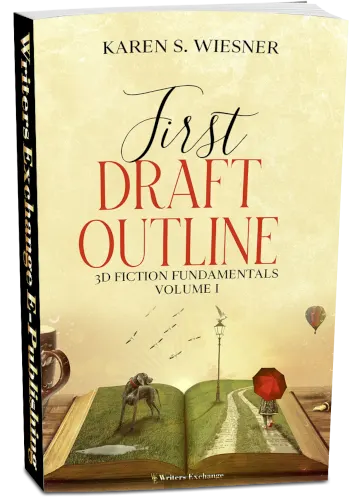
3D Fiction Fundamentals Series covers the A to Z’s of crafting the highest quality fiction including how to:
With step-by-step guidelines, instructions, and tips throughout that are flexible and clearly written, imparting a layman’s ease of understanding and can-do motivation, this collection may be the only writing craft books you’ll ever need. Each volume has a bonus companion booklet available presented in usable digital format or paperback that includes all the aids from the main book that you can use in your own writing–and extras!
Finish an outline so complete it reads like a first draft! Say goodbye to writing and rewriting with no results. Starting--and finishing--your story has never been easier.
First Draft Outline provides you with a sure-fire system to reduce time-intensive rewrites and avoid writing detours. Award-winning author Karen S. Wiesner's method shows you how to create an outline so detailed and complete that it actually doubles as your first draft. Flexible and customizable, this revolutionary system can be modified to fit any writer's approach and style. Plus, comprehensive and interactive worksheets make the process seem less like work and more like fun. This invaluable resource also includes:
-Itemized and flexible schedules to keep you focused each and every day
-Detailed worksheets to guide you through the outlining process
-Completed sample worksheets inspired by best-selling books
-Tips for outlining projects already in development
-Brainstorming techniques to keep you motivated
-Goal sheets for getting--and keeping--your career on track
Many aspiring and experienced writers toss out hundreds of pages (and waste valuable time) before they have a workable first draft of a story. You don't have to fall into this category anymore. With First Draft Outline, you'll have all the tools you need to write your masterpiece!
Also Available from these Retailers:







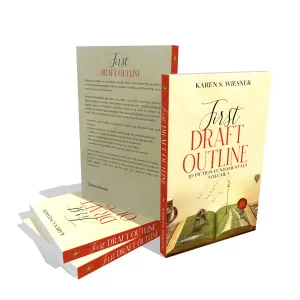
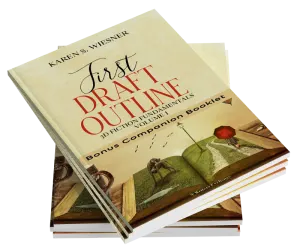
First Draft Outline Bonus Companion Booklet contains all the blank worksheets, checklists, charts, exercises, and/or other aids from the main book along with in-depth examples. This companion booklet is provided as a supplement, assuming readers have a working knowledge of the methods discussed in First Draft Outline. A free, editable digital file that allows users to type right into the document and use it over and over as needed
A print edition is also available for purchase. This bonus booklet also contains detailed exercises and examples

Making the First Draft Outline Method Work for You
"Credit belongs to...the man who actually strives to do the deeds, who knows the great enthusiasm and knows the great devotion, who spends himself on a worthy cause, who, at best, knows in the end the triumph of great achievement. And who, at worst, if he fails, at least fails while daring greatly..." ~Teddy Roosevelt
Imagine you could write the first draft of a story in only thirty days. Imagine you could figure out how long it would take to complete each step down to the day--that you could set accurate goals that would allow you to maintain a constant momentum in your writing career. Imagine writing quality books--each and every time--that no editor in his right mind could turn down. Everything you need is within your grasp. As you complete the first draft outline method explained in this book, you're going to discover much about yourself and your abilities.
My first draft outline method for outlining a story eliminates many of the problems that plague fiction writers. Why dig for plots blindly when, with a little preparation, you can craft something worthwhile from start to finish? Why go through countless, lengthy drafts of a story when you can create an outline so complete that it actually qualifies as the first draft? Why revise hundreds of pages of a complicated manuscript when you can revise a snapshot of your story that's a quarter of the book's length? Using an outline can significantly reduce the time it takes you to complete a project from start to finish--sometimes by more than half.
The method contained in First Draft Outline will work for any size story as well as for any genre of fiction. The method is good for any type of writer, whether you've just started writing or you've been at it for twenty-five years. It will work for you if you want clear direction from start to finish, and it will work for you if you simply want to use parts of the system to enhance your own way of writing. It will work for you if you are already productive and successful but yearn to take the world by storm.
You may be under the mistaken impression that using an outline stifles creativity, that you can't be productive in every aspect of your writing life. If you've never worked with an outline before or prefer a more leisurely method of working as you embark on what you see as a spiritual journey, adhering to this structured process may sound downright impossible--and in some cases, even horrifying. As you'll see, there's no wrong way to write a book--but there are ineffective ways of writing. Only you can decide if this method is for you. If you're not sure, try this method once (though it's best to try it at least two or three times) and see if it makes a big difference in what you're able to accomplish.
THE GOAL OF THE FIRST DRAFT OUTLINE METHOD
The outline you'll complete using the first draft outline method will become a snapshot of your story. After finishing a full outline, you should feel two things: (1) that you've got the makings of an entire book (your story should feel complete, solid, exciting, and wholly satisfying) and (2) that you still desperately want to write the book you've outlined.
A first draft outline completed using the first draft outline method is equivalent to the first draft of a manuscript. Because you've revised it so thoroughly, it reads with all the completeness and excitement of a finished story. Using your outline as you write the first draft of your book (which, in almost all cases, will be the final draft, needing only minor editing and polishing) should be so easy, you might even feel a little guilty about it. You will have done all the hard work creating the outline.
Throughout this book, we'll work on the assumption that the first draft of your book isn't a fully completed draft in the traditional sense, but instead a comprehensive outline--your first, whole glimpse of the book and a snapshot of what it will be once finished. The outline you create over the next thirty days will become the foundation upon which your entire story will come to rest. This method is a way to lay out the full course of the story as it flows from beginning to end. Your first draft is in outline form, not yet a fully realized manuscript. The first time you sit down to begin the actual writing process, you'll create your second--and in some cases, final--draft. (I also call this your first full draft.)
YOUR COMMITMENT TO THE FIRST DRAFT OUTLINE METHOD
Despite its flexibility, the first draft outline method requires a great deal of commitment from you as a writer. The first thing you need in order to become a productive writer is self-discipline. This method will give that to you in spades--if you're willing to dedicate yourself to doing your part. I won't pull any punches with you: Not everyone will be able to complete a first draft outline in exactly thirty days on the first try. Does that mean you'll never be able to do it? No, it doesn't mean that at all. This method, like all methods, requires a sufficient amount of practice. The longer you use it, the more you use it, the more time and effort you'll eventually shave off your outlining schedule. In the future, you may even notice it takes you considerably less time to write the first full draft of your book.
Does it mean you've failed if it takes you ninety days instead of thirty? Of course not. If you need more (or less) time to perform certain steps in the process, you can adjust your schedule easily. But this method will probably make you work harder than you've ever worked before. Some will enjoy the challenge. Others will use the method while setting their own deadlines for each step. And still others won't be willing to allow their muse to be harnessed in this way. Find what works for you over the long haul, not simply for the moment. Even if you find the next thirty days difficult, I encourage you to continue using this method for all of your projects. I promise you it will get easier with experience.
HOW TO USE THIS BOOK
First Draft Outline is broken down into ten chapters followed by four appendices. In chapter one, we'll discuss the various schedules that make up the first draft outline method and its six crucial stages. We'll also explore some brainstorming techniques because brainstorming is an essential part of this entire process.
Chapters two through seven will take you step by step through the six principle stages of the first draft outline method. Each stage is broken down into a certain number of days during which different segments of your outline will be developed, combined, and revised. Each chapter starts with a review of the schedule and prepares you for the work ahead.
If you already have a completed manuscript, you may want to read chapter eight before reading chapters two through seven. This chapter will show you how to use the first draft outline method to outline an already completed manuscript. By going back and outlining your completed manuscript, you can build on its strengths and eliminate its weaknesses, since the process of outlining will show you exactly where the story needs work.
Chapter nine will take you through the process of using your completed outline to write your manuscript. It will also discuss how to use writing and revision schedule sheets to keep yourself on track.
Chapter ten will show you how the structuring concepts of the first draft outline method can also be used to shape your career. In addition, you'll learn how to use goal sheets to stay focused on each of your projects.
The four appendices contain all the supplemental materials you'll need to work your way through the first draft outline method:
UNDERSTANDING THE FIRST DRAFT OUTLINE METHOD SCHEDULE
We'll discuss the first draft outline method schedules again and again throughout this book. Understanding what's happening on each day of the process will help you to stay focused and on track over the next thirty days. Keep in mind that as you become more experienced with outlining, you'll be able to make adjustments to the method and individualize it to best suit your needs.
Let's take a look at the overall schedule behind the first draft outline method.
Outline Schedule for a New Project
| Schedule | Stages To Complete | Days Required |
| Days 1–6 | Stage 1: Preliminary Outline | 6 |
| Days 7–13 | Stage 2: Research | 7 |
| Days 14–15 | Stage 3: Story Evolution | 2 |
| Days 16–24 | Stage 4: Formatted Outline | 9 |
| Days 25–28 | Stage 5: Outline Evaluation | 4 |
| Days 29–30 | Stage 6: Revise the Outline | 2 |
This is simply an overview of each stage. Keep in mind that each of the six stages identified above has its own day-to-day schedule. These individual schedules are discussed at length at the start of each corresponding chapter.
The first couple of times you use this method, you may find yourself struggling to stay on schedule. Don't worry if you need to allow yourself an extra day or two for some tasks. As you become more familiar with the method, you'll find it easier to stay on schedule.
While this method is specifically designed with the promise of completing a full outline before you begin writing the book, we'll talk about outlining and writing in tandem in chapter five, in case you find that you work better that way.
Please remember that the first steps in creating a comprehensive outline are very rough--each step will build on the previous one. The preliminary outline you create in Stage 1 won't contain everything. You'll just be getting your basics down at this point. With each step, you'll be developing more details about every aspect of the book, and your outline will grow to reflect that.
As you're writing the first full draft of your book, you'll also be re-evaluating your outline periodically as your story takes on a life of its own and moves in directions you might not have planned. You won't stop evaluating the strength of your outline until the book is complete.
WHAT YOU'LL NEED
In order to use this book, you'll need to have access to the basics: a computer, printer, pens, paper, paperclips, a stapler, and even scissors. You also may find it helpful to have expanding and two-pocket folders on hand to help you keep everything organized.
The first draft outline method can be completed using pens and paper or on a computer. If you use a computer, it's easiest to start a new document for most of the stages in the preliminary outline phase and to save each document to the same project folder. Also, always remember to print a clean copy of your document at the end of the day if you can afford it and it's practical to do so. This will keep you better organized and may just inspire a little brainstorming.
CREATIVITY AND OUTLINES
Before I tried writing an outline, I believed I simply couldn't learn to use one. Then I forced myself to try using an outline--my own version of an outline--for a book I'd already written numerous drafts of. First I sketched out a couple of chapters, and then I started writing the book once more. I completed the outline about midway through writing the first draft of the book. Not long after that, when I first used an outline for a brand new project, I found myself brainstorming constantly and productively. I was able to outline six to eight scenes of the book without writing a word of the actual story.
Since this meant that the outline was completed well ahead of the book, I was able to revise the outline instead of the story. A wondrous thing happened in this process: I saw the entire story from start to finish condensed in one place--including all the unworkable parts. All I had to do to strengthen the entire book was fix the unworkable elements in the outline.
Now when I write a story, I always start with a complete outline that I can revise as many times as I need to. Writing a book has almost become a simple process. After outlining, most projects require only one full draft and a final edit and polish. I save time, effort, and many, many intense rewrites. I can also write more "final draft" books a year, which means I have more to show for myself at the end of the year than a half dozen book drafts that need yet another overhaul.
I'll be the first to state emphatically that there is no wrong way to write a book. I've talked to hundreds of authors, published and unpublished, and all of them have their own unique ways of working. There's no wrong way, but some are less effective than others.
Sadly, too many authors believe outlines are a last resort. They see writing as a magical series of epiphanies that somehow takes them from the first page of a story to the last with little or no premeditation. I don't discount the magical element--because it is there in some degree--but I simply can't buy into the spiritual intuition way of writing. For one thing, not every brand-new, never-written-much-or-anything-before writer can be expected to have this kind of intuition. Any writer--experienced or not--who finds it difficult to develop plot and character as she writes can benefit from a structured outlining process.
Author John Berendt says, "Don't make an outline; make a laundry list. The very idea of an outline suggests rigidity; items on a laundry list can be shifted around. Don't lock the structure in too early. A piece of writing should evolve as it's being written." I hear the same thing from almost every writer I talk to, whether or not he's published: Writers like outlines about as much as a homeowner likes termites. The word can actually make some writers cringe and do a full-body shudder. An outline sounds like too much work; it's uninspiring, too confining, absolutely unappealing; necessitates the ability to see far ahead in a book; I can't possibly work that way!
Writers who haven't tried an outlining system have many questions about the process: Is it possible for an outline to be flexible? To take into account my individuality as a writer? Can I continue to be creative using an outline? Can I use an outline for writing in any fiction genre? Can using an outline reduce the number of rewrites I have to do? Can it really take me less time to complete a project from start to finish using an outline? Won't setting goals clip my wings rather than allow me to stretch them?
Despite their abhorrence of the word outline, many authors are seeking a method to give them direction, a method that embraces an individual's way of working, a method that takes away none of the joy of creating. They want something that will streamline the process and make them more productive, so they're not surrounding themselves with half-finished projects and manuscripts in need of major revisions.
If you are one of these authors, let me assure you: An outline can be flexible, can be so complete it actually qualifies as the first draft of the story. An outline can make it possible for writers like you to achieve more with less work, not only reducing the number of drafts required for each project, but perhaps even reducing the number to a single draft. This means producing more books and quite likely making more sales to publishers.
Instead of viewing an outline as an inflexible, unchangeable hindrance, imagine it as a snapshot of a book. A snapshot that captures everything the story will contain, but on a much smaller scale. Just as a photograph can be touched up, this snapshot of a book can be adjusted and rearranged until it's smooth, strong, and breathtakingly exciting. Revising a comprehensive outline of your story means revising fifty to a hundred pages instead of four times that. You must admit, my fellow writer, that an outline offers many benefits.
Without robbing you of the joy of your craft, First Draft Outline teaches you how to become a systematic, self-disciplined, productive author--no matter your genre or level of experience. While the technique behind the first draft outline method takes into account that you're an individual and may have your own methods of getting from Point A to Point B, it nonetheless helps clarify your vision of your story before you begin writing your first (and possibly final) full draft. No more wasted time or endless overhauls and revisions. The clearer your vision of the story before you start the actual writing, the more fleshed out the story will be once it makes it to paper.
IMPROVING YOUR PRODUCTIVITY
The method contained in this book, combined with the goal-setting suggestions in chapter ten, should cut in half the time it usually takes you to complete a project from outline to final draft. Of course, each writer is different and works at different speeds. A longer book may take longer to write. However, a more complex story won't increase your writing time because you'll work out the kinks of the story while outlining.
Before I started using the first draft outline method, I could write a full draft of a book in about two months--not counting all the time that I lost when my inspiration failed and I set the book aside and started a new one before eventually returning to the first one. It's also important to note that early in my writing career, I required twelve drafts per book to get something halfway decent. Later, by using my earlier drafts but not yet using an outline, I got that number down to four drafts per book. Do the math yourself: When I needed twelve drafts per book, it took me two years or more to complete one story. When I needed four drafts per book, it took eight months to complete a story.
Since I've been using the full outline process, the most time it takes to complete an outline of a book--regardless of length--is two to three weeks. And it only takes me one to two months to complete a first and final manuscript draft.
With each book you complete, your skills as a writer are likely to improve. You'll also increase your chances of making a sale if you have more than one book to shop around to publishers and agents.
SEE THE FIRST DRAFT OUTLINE METHOD IN ACTION
In this book, I use a wide variety of examples to demonstrate each step of the first draft outline method. Inspired by bestselling stories, these examples come from a variety of genres. They will show you just how versatile the First Draft Outline method is. You can use it for every single genre of fiction, no matter how short or long your work is.
However, it's equally important that you see the method used on a single book, the way you'll start out using it yourself. To this end, I've included examples of each step in the process taken from a single book in the First Draft Outline Bonus Companion Booklet, a separate booklet that includes all the worksheets and checklists used in this book. The free digital edition of the Bonus Companion Booklet actually allows you to type into the file, reusing it as many times as you need for all your projects. (A print edition is also available for purchase.) In the examples you'll also find there, you'll see the worksheets as I completed them for my paranormal romance book Sweet Dreams along with an excerpt to show you how the bones took on flesh. Seeing a cohesive picture of how the method works through every stage of my book will help you visualize how it works as you use it for your book. Find out more about this booklet by visiting https://www.writers-exchange.com/3d-fiction-fundamentals-series/.
DO I HAVE TO DO THIS FOREVER?
After the Writer's Digest Books edition of this book first came out, I was frequently asked whether all the pre-writing steps, checklists, and worksheets had to be completed with each writing project. The Story Evolution Worksheet (chapter four), for instance, is arduous. Am I suggesting every author should fill one out for every single project? No. God forbid. I wouldn't even do it for myself. The worksheet is for those who need more help with the development of story evolution. Some might only use it for a scene or two in their book--one that's giving them trouble. The same goes for tagging and tracing (chapter six). Do it when and where it helps you. Only you can know the circumstances that warrant its use.
I promise you, you won't always have to fill out so many worksheets and checklists--unless you want to continue with them. The longer you write, the more books you finish, the easier it should become. Writers grow more adept in our writing the longer we do it.
If you've never written a book before, you'll need the direction both of my books (and plenty of others) can give you. If you simply can't get some portion of your book to work, then all the checklists and exercises should help you figure out where your story is stuck or going wrong.
A writer usually spends a lifetime honing his or her process of writing. But the first step is locking down what works for you and what doesn't. Once you've used a method like those I advocate in my books often enough, you'll find that a lot of the writing process has become instinctive for you. You'll understand the importance of solid characterization now, whereas you may not have before. You'll comprehend how well-placed descriptions can enhance all the other parts of a book. Because so much of this has become instinctive for you, you may not have to formally complete setting sketches or plot sketches, etc., anymore. You'll do those things within the framework of your research and then within the outlining.
Whatever stage in your writing, I don't ever believe you should do more work than you need to. If you find yourself getting bogged down (either by the amount of time allotted--too much or too little--to each step, by an ability to progress with a step, or for any other reason), move on to the next step. If you don't need to follow a particular step in the process because you've already done it or it would just be unnecessary for you, you shouldn't do it. All of this stuff is designed to get writers thinking about areas that they've always seen as part of a whole, but that they've never before separated from the whole. In the beginning, you may need to perform all of those steps, filling out endless worksheets, etc., as you learn how to sufficiently develop each aspect of a book. But only do what you feel benefits you and your story.
All this said, I believe an outline is a crucial layer in developing every story. I don't really think you can "instinctively" grow out of needing one of those because it's really the ideal place the hard work of writing a book should be done.
GETTING STARTED
The first draft outline outlining process described in this book can allow you to harness your muse and put her to work so that you can become a more productive writer. You may feel that by harnessing your muse, you risk restricting your source of inspiration and creativity. Fear not. The First Draft Outline method merely directs your creativity so you can complete your writing projects quickly and easily.
If you're willing to take a leap of faith and commit yourself for the long haul, let's get started!
Without layering, a story is one-dimensional, unbelievable, boring. Set within the framework of comparing the process of building a house to the process of building a story, Cohesive Story Building gi…
Read More →
Writing the Standalone Series covers all things that need to be taken into consideration when writing a series and provides a one-stop resource. This guide gives writers everything they need for devel…
Read More →
The Overarching Series is the most complicated to read and write. Reader satisfaction comes through story arcs in each volume while the series arc only resolves in the final. Speculative fiction is we…
Read More →
Three-Dimensional Fiction Writing will help writers master the three-dimensional aspects of characters, plots, and settings using detailed sketches that define the past, present, and future aspects of…
Read More →
The three core elements of any story--Characters, Plots, and Relationships (CPR)--need to be developed three dimensionally. This resource teaches writers how to identify dead or lifeless characters, p…
Read More →
Crafting an effectively good back cover blurb is no easy task. A blurb needs to convince readers they have to read the story inside the pages...or they'll set the book down without ever opening it. Ad…
Read More →Karen Wiesner's FIRST DRAFT OUTLINE is an excellent approach to helping writers jumpstart their projects. It's well-written and personable--never boring. Most importantly, this straight forward, step-by-step approach succeeds in motivating writers to delve into writing their novels with a cohesive system that takes into account each writer's unique voice.
This is not just some boring how-to book. Instead, Karen's book manages to excite writers by showing them they actually can do this! It guides writers through important facets that lay the groundwork for their novels.
From the initial brainstorming and sketching out of a story's characters and plots, the writer begins to see the overall structure of their novel suddenly start to take shape. Additional chapters focus on research and the creation of the outline that then becomes the infrastructure for the novel. Karen then guides writers through each specific stage of their novel's beginning, middle, and end storyline arcs.
She provides an intelligent approach to setting reasonable goals that can actually be met. FIRST DRAFT OUTLINE just what it says. It's an inspiring and motivating resource that will exceed the expectations of most writers who may be intimidated at the process or have stalled in their writing projects.
Reviewed By: screenwriter/feature filmmaker Thomas Mignone
I’ve always been very suspicious of books or computer programs that offer up a system for writing. The methodologies proposed often claim to have nailed the perfect story structure, or character arc, and guarantee success if the writer sticks to the process described. Admittedly, a lot of these formulaic methodologies are aimed at people trying to write the next Hollywood blockbuster, but I’ve got an innate distrust of any process that claims to reduce the infinite variety of the novel down to a set of archetypes.
So it was with some suspicion that I came across Karen Wiesner’s FIRST DRAFT OUTLINE. I was faced with a significant rewrite and scratching my head about how to start. I’d always been a pantser, rather than a planner.
I’d have a strong opening, a rough idea of where it was all going, and I’d start writing, hoping that like a walk in the fog, the vague shapes ahead would resolve themselves as I made my way along the path. Then I saw that The Guardian newspaper was running a series called How to Write a Book in 30 Days, as part of NaNoWriMo 2012. So I thought what the heck and decided to give it a go.
It turned out that the article was exaggerating a bit. It was based on Karen Wiesner’s FIRST DRAFT OUTLINE, and at the end of it you would have a fully-defined outline with all the plot, characters, research and background in place, ready to fill up with the actual words, rather than a finished book. I quickly found that, for me, the approach she was advocating actually worked and I’m now a committed planner following a bastardised/simplified version of the Wiesner method, despite years of standing in the corner and laughing cynically whenever someone ran into the room waving the next copy of ‘Desmond Throckle’s Epic Story Crafter 2.0′.
So why am I hooked? To begin with Wiesner doesn’t really advocate a structural methodology–there’s none of this ‘Make sure your Contagonist enhances his feeling of Becoming before the Option Lock’ bollocks. The only approach she suggests is building a plot on a series of crises, failures and re-alignments, i.e.
Heroine tries something, Heroine Fails, Heroine Thinks of Something Else, Heroine Tries Again, Heroine Fails--rinse and repeat until Heroine Succeeds in the penultimate chapter. You don’t have to follow this–but it gives you a prompt to keep the tension going if you are writing an action thriller or similar. This helped me tick off one of the cast iron rules of fiction, that there must be clarity and pace at all times.
Essentially my version of Wiesner’s approach is as follows: 1) Sort out your characters 2) Sort out your locations 3) Decide your main plot 4) Toss in half a dozen subplots (including the romantic tension one) 5) Do your research/world building 6) Write a short outline 7) Rewrite the outline, each time expanding it to encompass plots and subplots, until you’ve turned your outline into a stack of ‘scenes’. And that, more or less, is it. It’s actually very simple, but if you stick to this approach you end with your story laid out in synopsis form, with all the plot wrinkles and character interactions sorted out before you start to write the actual words.
As Wiesner points out, if you find out something is not working and you only have a synopsis to change it’s a lot easier and less traumatic than having to go back and rewrite massive portions of the actual novel itself. The beauty of it is that the stress and chances of writer’s block are hugely reduced. If I get stuck on a scene I can skip it and write one further down the list, knowing that because the story is already worked out I’m unlikely to bugger up the continuity or development. I can highly recommend her planning methodology.
Reviewed By: author John Guy Collick
My bookshelves groan when they see me approach with a new craft book. I have so many that I hesitate to buy one in the bookstore for fear that I actually own a copy and it's just hidden behind a mountain of other books. I was given the opportunity to review Karen S. Wiesner's FIRST DRAFT OUTLINE and I think I can probably unburden my bookshelves.
Wiesner's book is good with a solid and doable process. And, honestly, the book reads like a friend who is telling you how to write your draft, a good friend, not one who will leave you in the lurch. I took the challenge of trying to write a first draft in 30 days following her method.
What makes FIRST DRAFT OUTLINE so essential is that even when Wiesner is explaining the basics of structure, you can't help but learn something. With each element that she explains, she illustrates it with excerpts from fiction you've probably read or, if you haven't, it's been on your list to read. Also, even if you are doing some of what Wiesner suggests, such as keeping a project folder, Wiesner illustrated how to organize your system so that it works for—not against—you and your book.
Wiesner's days are grouped into six crucial areas, so chapter three, for example, includes days 7 to 13, when she suggests you research your idea. By day 30, you are revising the formatted outline that provides your novel with its solid frame helping you to, as Wiesner writes, 'lay out the full course of the story as it flows from beginning to end.' She recommends using this full outline to set the stage for your second draft. This outline keeps your plot more focused and helps to avoid any pitfalls.
What worked for me with Wiesner's approach is that she gives you the steps—even providing the worksheets and schedules in her appendices—and encouragement for setting writing goals. Both are incredible for getting started on a novel or even with revising a novel. Even if you aren't sure that you want to follow an outline method, such as Wiesner proposes, FIRST DRAFT OUTLINE gave me some insight I needed about writing fiction.
In fact, I found myself making notes on how to revise a work-in-progress while drafting another manuscript! A WOW! Colleague told me she hoped Wiesner's book got my pen really moving.
It did and much more. It's not surprising; Wiesner is an accomplished author--talk about prolific! In a couple weeks, I'll review Wiesner's COHESIVE STORY BUILDING. I can't wait!
Reviewed By: Elizabeth King Humphrey for WOW! Women On Writing
Last month we reviewed Karen S. Wiesner’s COHESIVE STORY BUILDING. This book, FIRST DRAFT OUTLINE, is actually an earlier book and the focus is on helping you to create a system of creating an outline so detailed and complete that it is actually your first draft. The beauty is that Wiesner can teach you how to do this in just 30 days.
With this book, she hopes to save authors time and the heartache of having to toss out draft after draft of unfinished, not-quite-adequate fiction works. This book includes several worksheets and an enormous amount of information and instruction. She also offers examples, which I always find useful in the how-to books I study.
If you write novels or are thinking about writing one, consider purchasing both FIRST DRAFT OUTLINE and COHESIVE STORY BUIILDING. I’m writing a series of mysteries and I’m using both of these books in the process. Thank you, Karen.
Reviewed By: Patricia Fry, President of SPAWN
Novels are daunting, complicated, intimidating projects. FIRST DRAFT OUTLINE is a smart, sharp, tight step-by-step guide to outlining and wrapping our arms around the process. The guides, examples and worksheets give a writer no excuse to feel lost since Karen S. Wiesner holds your hand and leads you into the fear and out the other side with a solid first draft in hand. Remarkably sound textbook on how to get a novel out of your head and onto paper.
Reviewed By: author and editor C. Hope Clark
FIRST DRAFT OUTLINE by Karen S. Wiesner. Knowing nothing about the book except the summary on Amazon, I expected a book much in the same vein as Chris Baty's book. What a surprise upon reading Ms. Wiesner's book to find it was nothing at all like I was expecting, and a pleasant surprise at that. What I thought I was going to be reading would be an upbeat attempt to guide a budding writer into creating a plot from an idea and following a complete story arc--in a month. It's not really what I need, and it's not what Wiesner had to offer.
The 'first draft' referred to in the title of the book is not what I think of as a draft at all, but is instead a very thorough formatted outline, that while being created ends up generating a lot of documents to support the story. Wiesner's book turned out to be about workflow and creating a set of habits that will allow a writer to get from an idea in her head to a book in a very short amount of time.
Ms. Wiesner is a published author, though I've never read any of her books. But, the fact that she is an author is important in how she wrote this book. This was not an intellectual proposal for how someone should write a book, based upon potentially outlandish notions of the importance, and thus how long should be spent, various parts of the story. It's written matter-of-factly, with a 'this is what I do' attitude, that upon completion of the book makes it seem completely reasonable and more importantly something I am capable of doing.
Each of the chapters of the book is straight-forward--a boon in this type of book. We're given an introductory thought, an outline of the goal for specific days in the process, and then explanations of each part with examples from famous modern fiction, almost none of it her books, though apparently she has written quite a few. I take this for modesty as much as for the fact that this process is not terribly hard to reverse engineer for already written books, that were not only good enough to be published, but good enough to be famous--I may not have read half of them, but I had heard of all them.
Wiesner starts you off knowing that there are six parts to her program. It all sounds very rational and dare I say, doable. I quite liked how straight-forward and unmystical her writing was. I felt FIRST DRAFT OUTLINE was one writer talking to another, albeit an experienced, successful writer talking to someone yet to attain those goals. It's funny how sometimes in life you end up getting exactly what you need by accident. Just as I am getting ready to write a comprehensive outline for a writing project, I read a book that tells me how to do this.
Reviewed By: Unpublished author Eric
FIRST DRAFT OUTLINE gives a well-detailed, practical system of how to write a novel in a month. It can be personalized to work for anyone. Attempting to write a novel in thirty days is a tremendous undertaking.
Award-winning author Karen Wiesner insists that anyone can do this by using her system. In this book, she reveals how she keeps ahead of her writing deadlines and continues to write prolifically. For a writer looking for a method to write a novel quickly, this book is one to consider.
It's an essential tool for succeeding at NanoWrimo. Even if it is not used strictly on a thirty-day schedule, the method, charts, and forms will benefit writers looking for a way to write a novel in an organized manner. For more support on the second half of the process, Karen wrote COHESIVE STORY BUILDING. This book goes even deeper into her method and shows the writer how to turn the formatted outline into a well-written manuscript.
Reviewed By: Suite101.com
At this letter's writing, I have completed the third draft to a book I had been working on for years. The plot was very complex and I didn't have the tools to put it together. I came across FIRST DRAFT OUTLINE in my desperate search for an outlining system.
Up to then I worked with very little structure, believing that it would stymie my creativity. I wrote a book before on this principal and, all told, it took me years and dozens and dozens of rewrites to finally get the book in shape. Needless to say I didn't sell a million copies as so many fresh writers are prone to think.
I could only afford to promote it locally, but when venues to do this ran out I was faced with two dilemmas: come up with more money to promote it and writing another book. Then reality set in--it had taken six years to write that book! You can't make any money writing at that rate.
Let's face it, everyone wants to be Stephen King or J.K Rowling, or Grisham or Sheldon but most of us aren't. But with a system like Mrs. Wiesner's it is possible to be more productive and that's what I was looking for, got, and all I expect from it. The key here is PRODUCTIVITY.
By the way, when I got her system it took a while to clean up my WIP because of how messy it was. But her system enabled me to see all that I had done wrong. My book had guts and a soul, but it was just too fat and we started there, trimming it down and laying everything out on the table.
We took out all the defective parts and fixed the ones that were absolutely essential, built a skeleton and slowly put them back in. Now it wasn't easy by a long-shot but after a while I could see how this baby, the one I'd been feeding and carrying for so many years would look like. When I finished it I allowed it to sit, as Wiesner recommended, and started another Idea, this time using her system from scratch.
I couldn't believe it. I finished this Idea completely, from brainstorming, through research, preliminary and finally, the formatted outline in FOUR WEEKS! Two weeks following this I went back to my previous project and as suggested in her book, looked it over again and the perspective of six weeks away showed me even more than I saw when I left it.
The moment of truth came and I started writing from her FORMATTED OUTLINE format. It was baby steps at first but soon I discovered that this system of ORGANIZATION didn't stymie creativity, in fact I felt liberated. Free from worrying about what to say or how to describe scenes, point-of-views, all those little things that can obscure the real truth of the story itself.
Really it was like fitting puzzle pieces together, each scene locking perfectly and tightly with the next. I couldn't believe it; my wife couldn't believe it. Things in my life had gone from being impossible to 'here and now'.
My biggest regret in life is that I didn't come across this system sooner. There are some good books on writing out there, from THE FICTION WRITER'S HANDBOOK by Hallie and Whit Burnett, THE WRITING HABIT by David Huddle and even Stephen King's ON WRITING. FIRST DRAFT OUTLINE is far, far superior in the same way as the computer is over the old IBM typewriters I used in school years ago.
Stephen King's a great writer, some would argue a genius, but try to write as he suggested in his book and you'll find yourself rewriting every draft and ultimately discouraged altogether. ON WRITING is a great book with a lot of invaluable insight and info but if you want to survive in this game and write more than one book every ten years and write something you can be proud of, get Mrs. Wiesner's system.
Reviewed By: Unpublished author
Bought this book from us? Write a review from your account page — it appears here once approved.